
Published Date: Mar 25, 2026 | Last Updated: Jun 30, 2026
Written by: Emma Cyrus, Senior Copy, Content & Editorial Writer
Reviewed by: Benjamin Ibanez, Senior Interior Designer at FCI London
Edited by: Zoona Sikander, Head of Content
Estimated Reading Time: 8 minutes
TLDR: A walk-in wardrobe works when it is designed around how you actually live, not how a showroom photograph suggests you should. Audit your wardrobe before touching the layout, zone by frequency of use, invest in the right internal fittings, and treat lighting and finish as functional decisions rather than decorative ones. The rest follows.
There is a particular kind of frustration that comes with a walk-in wardrobe that looks the part but fails to function like one. You have the square footage. You have the commitment to doing it properly. And yet, somehow, the space still feels like a beautifully dressed version of chaos.
In my years working with clients across London and beyond, this is one of the most common situations I encounter, and it is almost never about lack of space. It is about the decisions made before a single shelf was fitted.
The difference between a walk-in wardrobe that genuinely works and one that merely looks impressive in a photograph comes down to a handful of principles that, frankly, most people are never told.
So consider this the conversation you should have had before the fitted wardrobe project started.
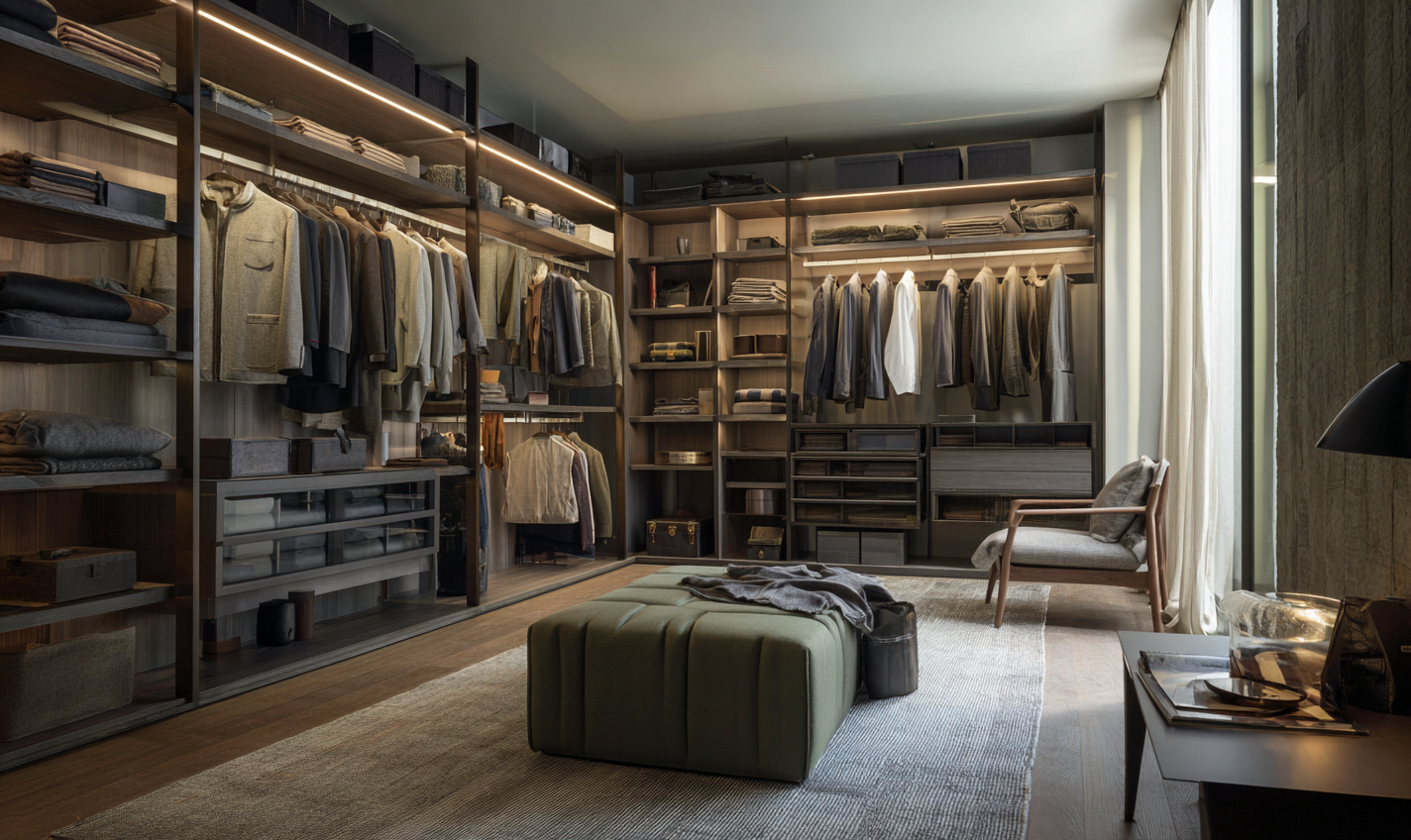
Table of Contents
The single most consequential mistake I see is designing the space before auditing the wardrobe itself. People arrive at the design stage with a vague sense of what they own, and the result is a storage system built around assumptions rather than reality.
Before any conversation about finishes, configurations, or Italian cabinetry, I ask clients to do one thing: pull everything out and categorise it. Not just into broad groups like "shirts" and "shoes," but into a genuinely granular inventory. How many items require full-length hanging? How many folded items will you realistically rotate? How many shoes are in active use versus occasional wear? Do you store bags vertically or flat?
This exercise is never glamorous, but it is the foundation upon which every good wardrobe design rests. It tells you exactly how much of each type of storage you need, which in turn determines the internal configuration of every unit. A client with an extensive shoe collection, for example, needs a very different approach to vertical space than one whose priority is suiting.
The room responds to the wardrobe. Not the other way around.
Key takeaways: Audit your wardrobe before designing the space. Categorise by item type and frequency of use. Let the inventory dictate the configuration, not the other way around.
One of the storage secrets that separates a designer-led wardrobe from a well-intentioned DIY arrangement is the concept of frequency zoning. The principle is straightforward: the things you reach for most often should require the least effort to access.
In practice, this means your prime real estate, roughly between hip and shoulder height, should be reserved entirely for your most-worn items. Everything else cascades outward from there. Occasional-wear pieces, seasonal storage, and formal attire that comes out a handful of times a year all belong in the secondary zones: high shelves, deep drawers, and the outer reaches of the layout.
This sounds almost too obvious to mention, but the number of wardrobes I have walked into where a client's daily shirts are stacked on a high shelf while their guest-bedroom quality bedlinen occupies prime hanging space is remarkable. The wardrobe was designed with good intentions and very little thought about how it would actually be used on a Tuesday morning.
Frequency zoning also applies horizontally. If your wardrobe wraps around three walls, your daily rotation belongs on the wall you face when you walk in. The side walls handle everything else.
Key takeaways: Reserve hip-to-shoulder height for daily essentials. Push occasional and seasonal pieces to high shelves, deep drawers, and peripheral sections. Apply the same logic horizontally, with the most-used items directly in your line of sight.
Once zoning is established, the internal configuration of each section deserves serious attention. This is where the quality of bespoke Italian wardrobe systems becomes genuinely apparent, because the range of internal fittings available through a specialist is categorically different from what you will find anywhere else.
Hanging sections seem simple until you start making distinctions. Double-hanging rails for shorter items, such as jackets, shirts, and folded trousers, recover a significant amount of vertical space that single-hang arrangements waste entirely. For formal garments and full-length pieces, single-hang sections with generous clearance are non-negotiable. Many clients are surprised to discover that their wardrobe needs both, and in thoughtfully calculated proportions.
Drawer configurations are where I spend a disproportionate amount of time in client consultations, because the choices are more consequential than people expect. Shallow drawers are ideal for accessories, ties, and folded knitwear. Deeper drawers suit heavier folded items. Velvet-lined jewellery drawers, pull-out trouser racks, and internal divider systems are not flourishes: they are tools that determine whether a drawer is genuinely usable or simply a place where things accumulate.
Shelf depth is frequently underestimated as a variable. Standard shelving depths work for folded clothing, but they are insufficient for larger bags, hat boxes, and certain types of footwear. Adjustable shelving, available in the bespoke systems we specify at FCI, allows the wardrobe to evolve as your needs change, which is a far more intelligent approach than fixing every dimension at the outset.
Pull-out fittings deserve particular mention. Pull-out shoe racks, valet rods, belt and tie organisers, and retractable mirrors transform what would otherwise be static storage into a highly functional system. The valet rod is one of my personal recommendations for clients who travel frequently or prepare outfits in advance: a small addition that proves its value every single day.
Key takeaways: Use double-hanging rails to recover wasted vertical space. Invest time in drawer configuration - depth and internal dividers matter more than most people expect. Specify adjustable shelving where possible, and do not overlook pull-out fittings. They earn their place daily.
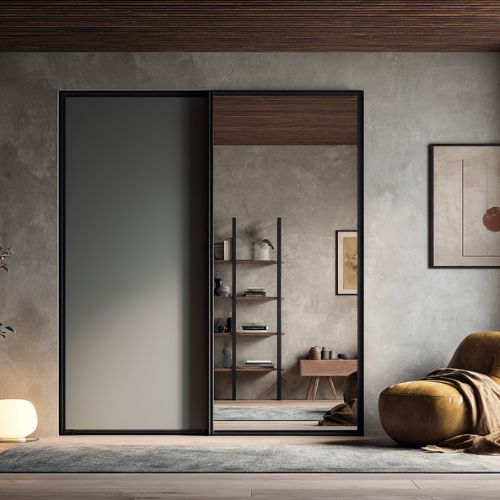
At FCI, we work with some of the finest Italian wardrobe manufacturers in the industry, and one of the genuine pleasures of this work is the breadth of customisation available. Finishes range from lacquered glass and matte lacquers to natural veneers, textured fabrics, and high-gloss options that photograph beautifully and hold up equally well in daily use.
The material and finish decisions in a walk-in wardrobe are not purely aesthetic. They affect the perception of space, the quality of light within the room, and the overall sense of being in a space that was designed with intention. A wardrobe clad in a pale, matte finish will feel open and calm. The same space in a deep, richly grained walnut veneer becomes intimate and considered. Neither is correct in the abstract: both are correct in the right context.
One consideration I consistently raise with clients is the relationship between the wardrobe interior and the room beyond. Where the wardrobe is visible from a bedroom, the door and carcass finishes should form part of the broader interior conversation. Where the wardrobe is a room in its own right, there is greater latitude to treat it as a self-contained design statement.
Lighting, incidentally, is not an afterthought. Integrated LED lighting within hanging sections, beneath shelves, and inside drawers is now standard in well-specified Italian systems, and it transforms the functionality of the space entirely. A wardrobe that is adequately lit from within is a wardrobe you can actually navigate.
Key takeaways: Choose finishes in relation to the room they sit within. Consider how the wardrobe reads from the bedroom beyond. Treat integrated lighting as a functional essential, not a finishing touch.
In the spirit of genuine usefulness, here are the errors I see most consistently, even in otherwise well-conceived projects.
Over-indexing on hanging space. The instinct is always to maximise hanging, but most wardrobes are better served by a more balanced split between hanging, shelving, and drawers. Folded items take up less space than hung equivalents for much of your wardrobe, and a thoughtful combination of storage types is almost always more efficient.
Ignoring the door strategy. Whether your wardrobe uses hinged or sliding doors has significant implications for the internal layout and the surrounding room. Sliding doors are practical in tighter spaces but limit access to the full width of a section at any given moment. Hinged doors offer complete access but require clearance. The decision should be made early, not retrofitted.
Underestimating seasonal storage. Seasonal items need a home, and that home should not be the most accessible part of your wardrobe. Dedicated high-level storage for out-of-season pieces, properly contained in appropriate boxes or bags, keeps the active wardrobe uncluttered and easy to navigate.
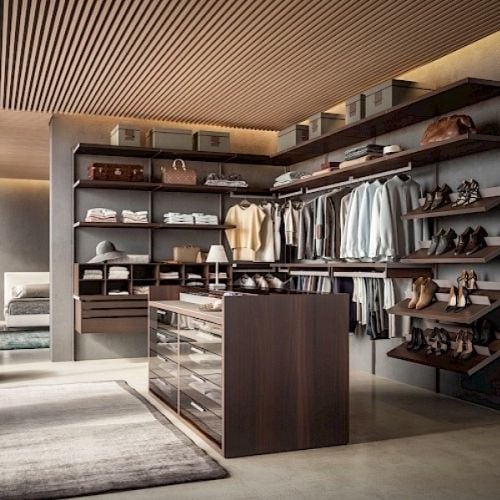
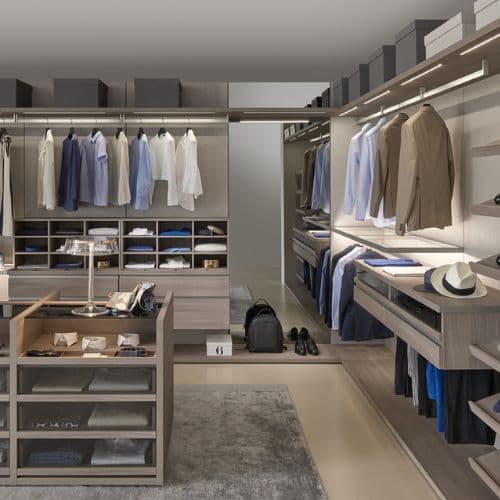
Treating the island unit as optional. For walk-in wardrobes with sufficient floor space, a central island unit with deep drawers and a surface above is one of the most practical additions possible. It provides a place to lay out, fold, and organise, and the drawer storage it offers tends to be the most ergonomically accessible in the entire room. Clients who initially question whether they need one rarely want to be without it once it is in place.
Key takeaways: Balance hanging with folded storage and drawers. Decide on door type early, as it shapes the entire layout. Plan for seasonal storage from the outset. If the footprint allows, include a central island - it is rarely regretted.
A bespoke walk-in wardrobe is an investment in how you live, and it is worth approaching it with the same long-term thinking you would apply to any other significant interior decision. The Italian systems we specify through FCI are designed with longevity in mind, both in terms of material quality and the flexibility of internal configurations that can be adjusted as your life and wardrobe evolve.
The clients who are most satisfied with their walk-in wardrobes are invariably those who gave the project the same level of consideration they gave their kitchen. They audited what they owned, thought carefully about how they actually use the space each day, and worked with a designer rather than around one.
If you are at the stage of considering or refining your walk-in wardrobe, the most valuable next step is a conversation with a specialist who can translate your requirements into a configuration that genuinely works. At FCI, that conversation begins in the showroom, where you can experience the finishes, fittings, and quality of the systems we work with firsthand. It is the kind of decision that rewards the investment of time at the front end, and the kind of result that rewards you every morning for years to come.
Address & Hours:
FCI London, Rays House, North Circular Road, London, NW10 7XP
Monday - Saturday: 10am - 6pm
Sunday & Bank Holidays: 11am - 5pm
Contact Details:
Phone: +442081531235
Email: [email protected]
What to Bring:
"I had an excellent experience with FCI. Their showroom offers an impressive selection of high-quality furniture and top international brands. The team provided outstanding service - knowledgeable, attentive, and genuinely helpful."
Zlata Rybchenko
"Service was personalised and excellent. Sanjay guided us through the entire process, ensuring we were satisfied with our choices. The delivery guys were amazing and went the extra mile."
Chava Kahn
"FCI, and Kasia in particular, provide an excellent service to design professionals and the trade. Their expertise, helpful 'can-do' approach, assistance and attention to detail are second-to-none."
Mike Jenkins
We help designers & clients transform mundane spaces into extraordinary ones.


Book a video consultation and we'll advise you on furniture, space planning, colour schemes and much more.
Book A ConsultationBook a visit to our stunning, multi award-winning, 30,000 sqft.
Over 700 brands under 1 roof.
Most Popular on FCI London: Fitted Wardrobes | Luxury Designer Rugs | Luxury Sofas | Luxury Furniture Store | Luxury Interior Designers | Luxury Bedroom Furniture | Luxury Modern Chairs | Luxury Coffee Tables | Luxury Designer Kitchens | Luxury TV Units | Luxury Dining Tables | Luxury Storage Solutions | Luxury Sideboards | Luxury Stools & Bar Stools | Luxury Bespoke Joinery | Luxury Modern Hallway Furniture | Furniture Showroom Appointment | Luxury Lighting | Modern Luxury Outdoor Furniture
Transparency isn’t a policy. It’s a principle.
Have a peek at what our clients really have to say.