
Published Date: Mar 17, 2026 | Last Updated: Jun 30, 2026
Written by: Emma Cyrus, Senior Copy, Content & Editorial Writer
Reviewed by: Cristina Chirila, Senior Interior Designer at FCI London
Edited by: Zoona Sikander, Head of Content
Estimated Reading Time: 8 minutes
TL;DR: Made to measure wardrobes are designed to the precise dimensions of your space, eliminating the visual and functional shortfalls that standard units invariably leave behind. From floor-to-ceiling configurations and sliding or hinged door styles to fully specified interiors, every element is resolved around how you live. FCI London offers end-to-end design, visualisation, and installation - so the result is a wardrobe that feels less like furniture and more like architecture.
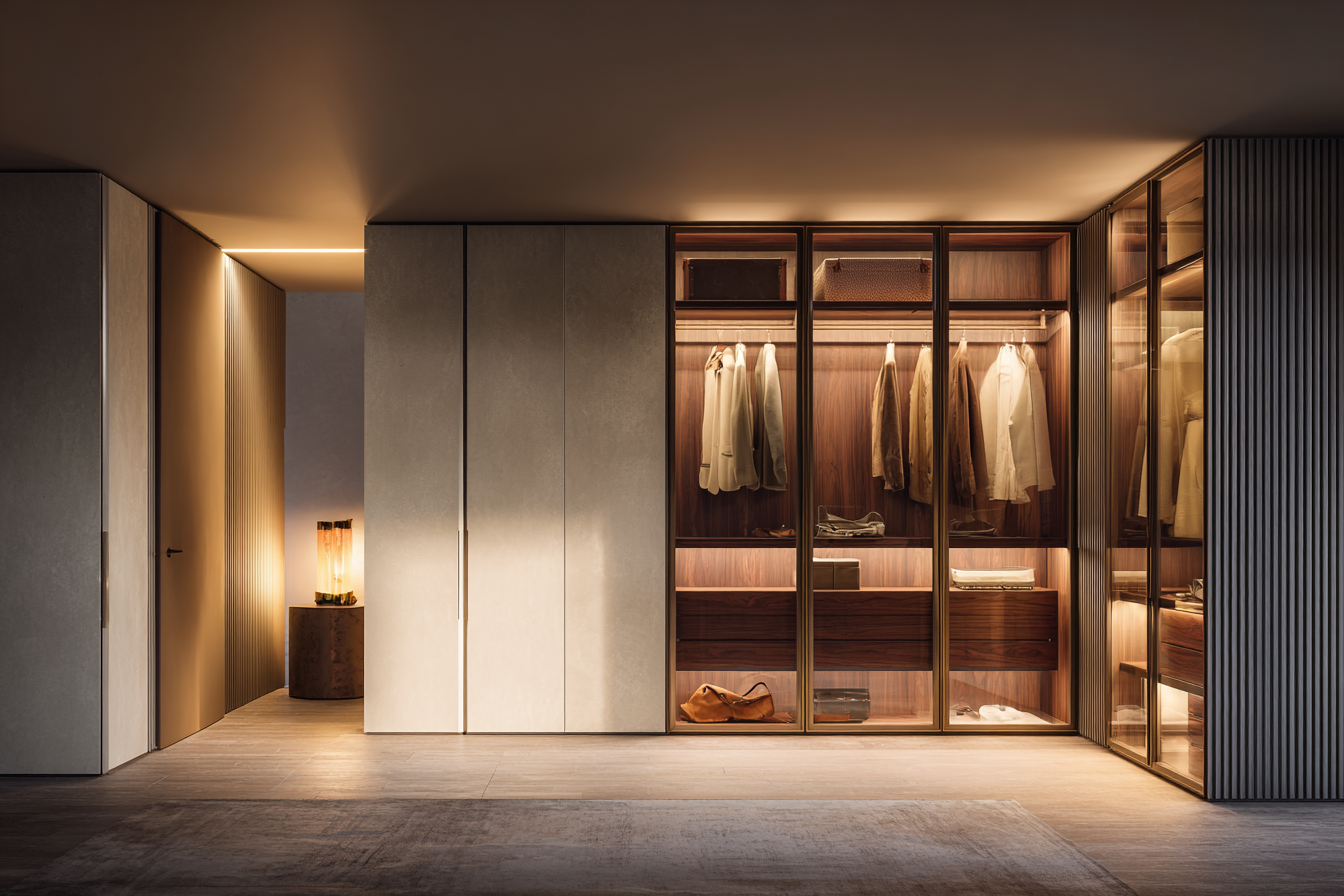
There is a particular kind of frustration that settles in quietly - the sort you don't notice until you're standing in your bedroom at seven in the morning, trying to locate a shirt, while a wardrobe door that never quite sat flush hangs slightly ajar, mocking the entire room.
I've seen it more times than I care to count in my years working with clients across London and beyond. The wardrobe was an afterthought. The doors, even more so.
Made to measure wardrobes are, in my experience, one of those investments that reveal their true value gradually - in the way a well-tailored suit does, rather than a statement piece you wear once.
They do something that standard, off-the-shelf alternatives simply cannot: they respect the room. And in a home of genuine quality, that distinction matters enormously.
Here's something that doesn't get said often enough: most residential architecture in the UK - particularly in older properties and high-specification new builds alike - is not designed around standard wardrobe modules. Period homes in areas like Hampstead carry charming irregularities; alcoves that are 2,340mm wide rather than 2,400mm, ceilings that climb to heights no flat-pack unit was ever designed to meet.
The result, when standard wardrobes are forced into non-standard spaces, is a visual compromise that accumulates over time. Gaps at the top. Skirting boards that interrupt the base. A slight lean that no amount of adjustment will fully correct. For clients whose homes represent a meaningful investment - and whose eye for detail is precisely what brought them to a designer in the first place - these imperfections are not trivial.
A made to measure wardrobe eliminates the compromise from the outset. It is dimensioned to the millimetre, engineered to the specific conditions of your space, and finished to sit as though it were always meant to be there. Which, of course, it was.
The phrase is sometimes used loosely in the industry, so it's worth being precise. A true made to measure fitted wardrobe is produced to your exact specifications - height, width, depth, and internal configuration - rather than selected from a finite range of pre-set modules.
This is not the same as "available in multiple sizes," which still confines you to someone else's notion of what a wardrobe should be.
In practice, made to measure wardrobes can accommodate heights from around 1,800mm up to 2,800mm or beyond for rooms with generous ceiling heights. Door panel widths typically range from 450mm to 1,000mm depending on the system, with the number of panels determined by the total opening width and the proportions that will read best in the space.
One of the more considered decisions at this stage is the relationship between door panel width and room proportion. Wider panels create a sense of calm continuity - fewer vertical lines interrupting the wall.
Narrower panels introduce a rhythm that can suit more formal or traditional schemes. Neither is categorically correct; both require an understanding of the room's geometry and the furniture it will share space with.
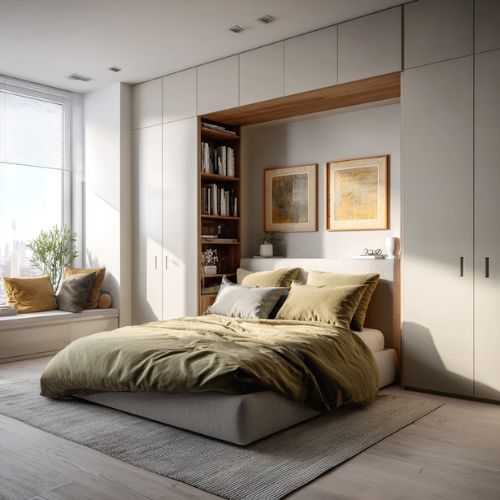
Floor-to-ceiling configurations deserve particular attention. When a wardrobe runs the full height of a room, it performs an architectural function as much as a storage one - drawing the eye upward, reinforcing the sense of volume, and integrating seamlessly into the fabric of the room rather than sitting in front of it.
For bedrooms where the ceiling height justifies it, I rarely recommend anything less.
The door is, in many ways, the face of the wardrobe - and by extension, a significant contributor to the bedroom's overall character. The range of styles available in a properly specified made to measure wardrobe is considerably broader than most clients initially assume.
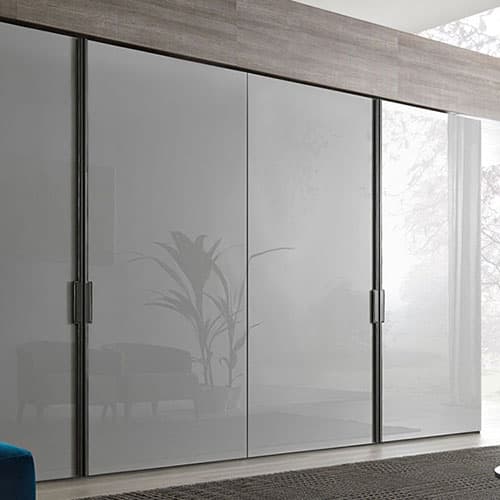
Sliding versus hinged is the first decision, and it's driven as much by practicality as preference. Sliding fitted wardrobes are the natural choice where floor space is at a premium - they require no swing clearance and maintain a clean, unbroken facade.
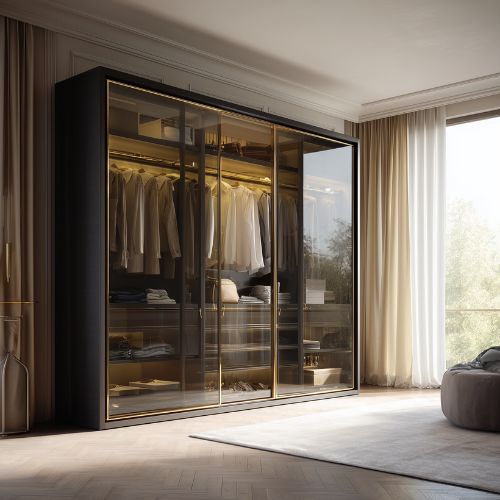
In a well-proportioned bedroom, I recently specified a three-panel sliding wardrobe in brushed bronze and fluted glass that effectively became an architectural feature in its own right. Hinged doors, by contrast, offer full, unobstructed access to the interior - something clients with extensive wardrobes often prefer - and can accommodate more elaborate detailing, from stepped profiles to applied mouldings.
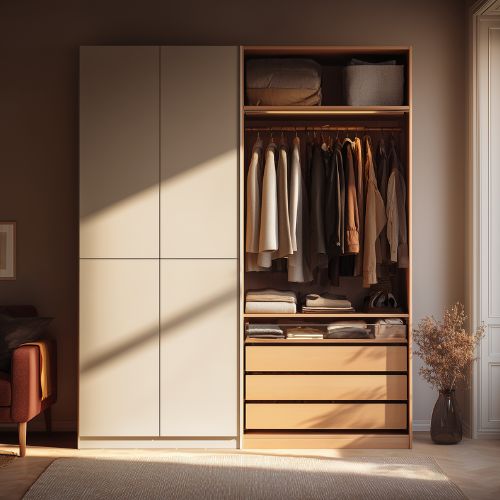
Frame and panel construction remains perennially relevant for traditionally styled interiors. Shaker-profile doors in particular have endured precisely because they occupy a middle ground between decorative and restrained - they add visual interest without demanding attention. For more contemporary schemes, frameless slab doors in lacquered or veneered finishes deliver the kind of clean geometry that reads well against modern architecture.
Glass and mirror inserts introduce light - both literally and figuratively - into a bedroom. Full-length mirrored doors serve an obvious practical function while making smaller rooms read as considerably larger. Smoked or antiqued glass offers a more considered alternative for clients who want the lightness without the reflectivity. Fluted, reeded, or ribbed glass panels have seen a significant resurgence in recent years and offer genuine textural sophistication when paired with the right frame.
Material and finish is where personal taste and practical requirements converge. Lacquered finishes offer depth of colour and a refined, seamless appearance. Timber veneers - walnut, oak, and ebonised finishes among them - bring warmth and grain to a scheme. For clients drawn to natural materials, the texture of a real wood veneer in raking light is something no photograph quite captures; it must be experienced in person to be fully understood.
In my experience, the most consistent errors in wardrobe specification fall into a predictable pattern. The first is selecting the wardrobe before understanding the room. A made to measure piece should be designed in response to the space - its proportions, its light sources, its existing materials - not chosen independently and installed in hope.
The second is underestimating the hardware.
Tracks, rollers, hinges, and handles are not incidental components. The quality of the sliding mechanism determines how the wardrobe feels to use every single day, and the handle - or the absence of one, in a push-to-open configuration - contributes materially to the overall aesthetic. Specifying a beautifully crafted door panel and pairing it with inadequate hardware is, I'm afraid to say, a reasonably common oversight.
The third, and perhaps most important, is attempting to measure and specify independently without professional input.
The tolerances involved in made to measure joinery are precise, and the consequences of an error - a door that binds, a frame that twists, panels that don't align - are both costly and deeply irritating to live with. A proper survey, carried out by someone who understands how rooms move and settle, is not an optional luxury.
When I'm working through a bedroom wardrobe scheme with a client, the wardrobe is never considered in isolation. It exists in relation to the bed, the floor material, the ceiling height, the window placement, and the overall palette.
The best made to measure wardrobes are the ones you notice least - not because they're forgettable, but because they integrate so completely that their absence would be immediately felt.
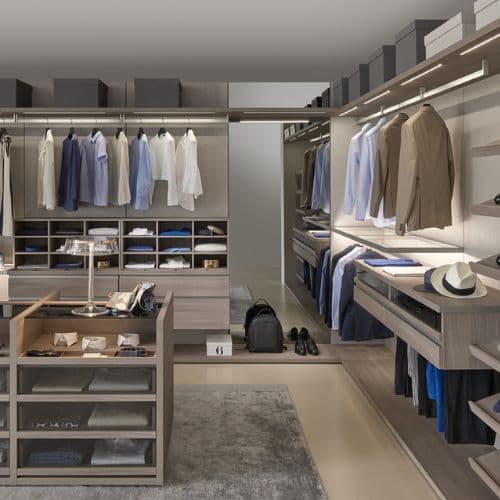
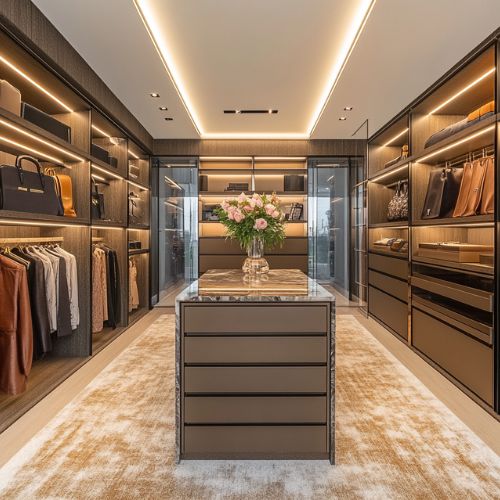
There is also the matter of the interior configuration, which is where a well-specified wardrobe genuinely earns its place. A beautifully resolved exterior that opens onto a poorly organised, poorly lit interior is a disappointment that many clients don't anticipate until it's too late.
At FCI London, the internal layout - shelving, hanging sections, drawer configurations, integrated lighting, shoe storage, and pull-out accessories - is designed with the same precision and intention as the exterior. It is, in the fullest sense, a complete wardrobe solution rather than a surface-level one. The distinction between a wardrobe that stores your belongings and one that genuinely serves your daily routine is more significant than it sounds.
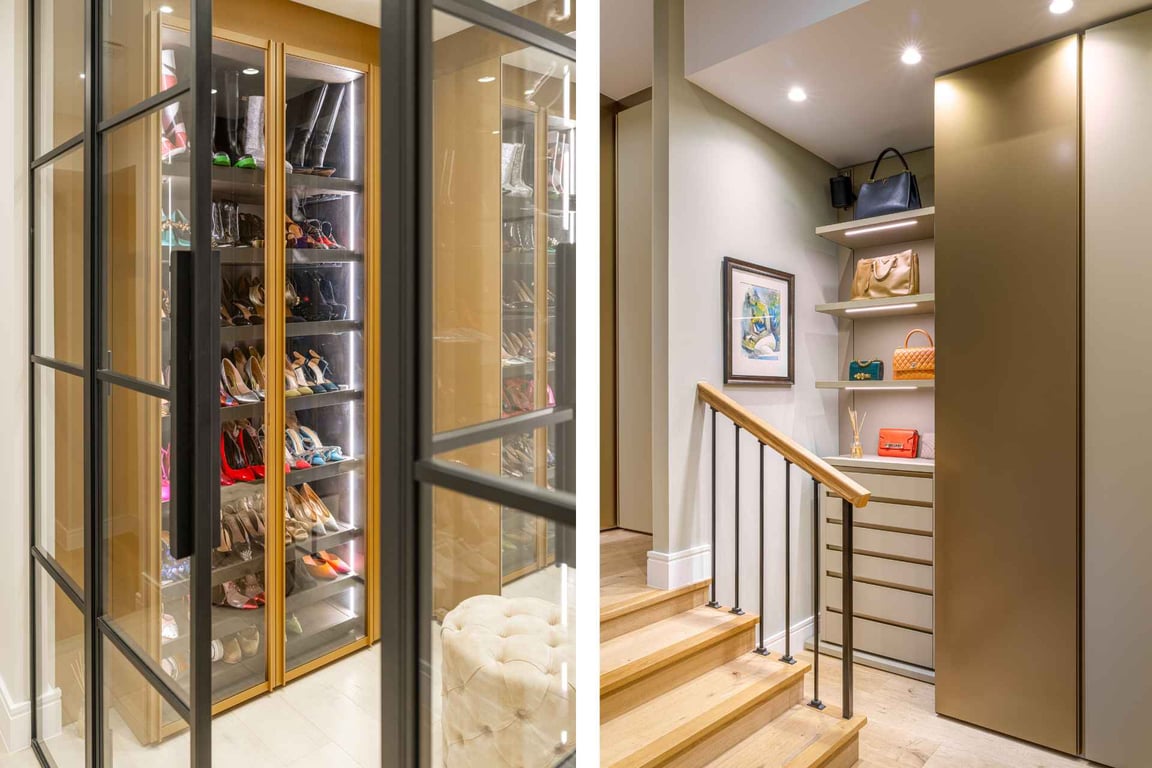
One of the more memorable wardrobe briefs I've encountered came from a client at Hollycroft Avenue, whose master suite needed to work as hard as it looked. Her requirements were specific: a wardrobe that put her shoe collection on display rather than behind closed doors, and a secondary storage solution for her bags that felt considered rather than concealed.
We resolved the first with glazed wardrobe doors - clear, frameless panels that transformed her stiletto collection into something closer to a curated installation than a storage arrangement. The second called for a bespoke under-stair wardrobe, split between a closed section with a full door on one side and open shelving on the other, purpose-built to house her bag collection in a way that was as visually intentional as anything else in the home.
It's a FCI London project that illustrates something I find myself returning to often: the best wardrobe brief isn't really about storage at all. It's about understanding how someone lives, what they value, and designing a space that reflects both with complete precision.
If you are considering a made to measure wardrobe for a bedroom project - whether a new build, a renovation, or simply a room that has quietly bothered you for longer than you'd care to admit - the most valuable first step is a conversation with a designer who understands both the product and the space it will inhabit.
At FCI London, our design consultants work through exactly this kind of specification process from the earliest stages of a project. We offer 3D visualisation as part of our consultation service, so you can see how a proposed wardrobe reads in the context of your actual room before a single measurement is committed to production.
It is, in my view, the only sensible way to approach a decision of this significance - and one that invariably saves both time and the particular quiet frustration of a wardrobe that never quite feels right.
Your wardrobe should function as well as it looks. In that respect, made to measure is not an indulgence. It is simply the correct approach.
Address & Hours:
FCI London, Rays House, North Circular Road, London, NW10 7XP
Monday - Saturday: 10am - 6pm
Sunday & Bank Holidays: 11am - 5pm
Contact Details:
Phone: +442081531235
Email: [email protected]
What to Bring:
A made to measure wardrobe is, ultimately, an exercise in getting things right rather than getting them done. The difference between a bedroom that functions beautifully and one that merely contains furniture often comes down to decisions made at precisely this level of detail - the height of a door panel, the grain of a veneer, the internal layout designed around how you actually live. At FCI London, we bring that level of consideration to every project we undertake, from the first conversation through to installation. If your bedroom deserves better than a compromise, and it does - we'd welcome the opportunity to show you what made to measure really means.
Nedelia Martin
"I discovered FCI London almost 5 years ago, and I keep going back to them when I need to buy furniture. The team is fantastic, both the sales staff and the in-house designer were knowledgeable, helpful, and really took the time to understand my style."
Chava Kahn
"Service was personalised and excellent. Sanjay saw us through the process from start to end, ensuring that we were happy with our choices. The delivery guys were amazing and went the extra mile."
Mike Jenkins
"FCI, and Kasia in particular, provide an excellent service to design professionals and the trade. Their expertise, helpful 'can-do' approach, assistance and attention to detail are second-to-none."
We help designers & clients transform mundane spaces into extraordinary ones.


Book a video consultation and we'll advise you on furniture, space planning, colour schemes and much more.
Book A ConsultationBook a visit to our stunning, multi award-winning, 30,000 sqft.
Over 700 brands under 1 roof.
Most Popular on FCI London: Fitted Wardrobes | Luxury Designer Rugs | Luxury Sofas | Luxury Furniture Store | Luxury Interior Designers | Luxury Bedroom Furniture | Luxury Modern Chairs | Luxury Coffee Tables | Luxury Designer Kitchens | Luxury TV Units | Luxury Dining Tables | Luxury Storage Solutions | Luxury Sideboards | Luxury Stools & Bar Stools | Luxury Bespoke Joinery | Luxury Modern Hallway Furniture | Furniture Showroom Appointment | Luxury Lighting | Modern Luxury Outdoor Furniture
Transparency isn’t a policy. It’s a principle.
Have a peek at what our clients really have to say.