
Published Date: Jun 29, 2026
Written by: Emma Cyrus, Senior Copy, Content & Editorial Writer
Reviewed by: Andrei Lee, Senior Interior Designer at FCI London
Edited by: Zoona Sikander, Head of Content
Estimated Reading Time: 10 minutes
TL;DR: Open planing only works when each zone in the space has a clearly defined identity and a very clear relationship to the other zones around it. In this blog, we have shared 11 ideas based on different open plan projects that our design team has been working on - we cover everything from triple zone layouts to integrated bars and some statement making accessories as well as living spaces that extend to the outdoors. So whether you are designing or furnishing a small or a large space, if open plan feels like the right direction, here are all the principles that can make it work. The main thread across all of them is a controlled restraint in materials, the right choice of furniture and the attitude to give a purpose to every corner of the room.
Table of Contents
If you are planning on refining an open plan living space and want some real ideas rather than unrealistic Pinterest mood boards - this blog is for you. Even those who have a floor plan but haven't figured out the zoning framework of the furniture, will find these tips quite useful. We're going to look at eleven recently completed FCI London projects - each with a very considered brief, a specific room and a very specific way of living around which it was designed. We're sure that our clients will be enjoying these spaces for decades and you too can take a lot of valuable lessons from them.
A quick google or Instagram search will tell you that open plan living ideas are not in short supply - you can litterally find heaps of information on them in seconds but what is in short supply is the analytical thinking behind them. Anyone can remove a wall and fill it up with their favourite pieces of furniture but thinking about how the different zones will work, how they relate to each other, where does the eye settle first, what materials carry the room and which are the supporting materials - all of that is real work that only a real designer can help you with.
Between us, my team and I have worked on more open plan schemes this year than we can even count. Here are some of our favoruite ones - each with a different answer to the old age question of how to make a shared space work.
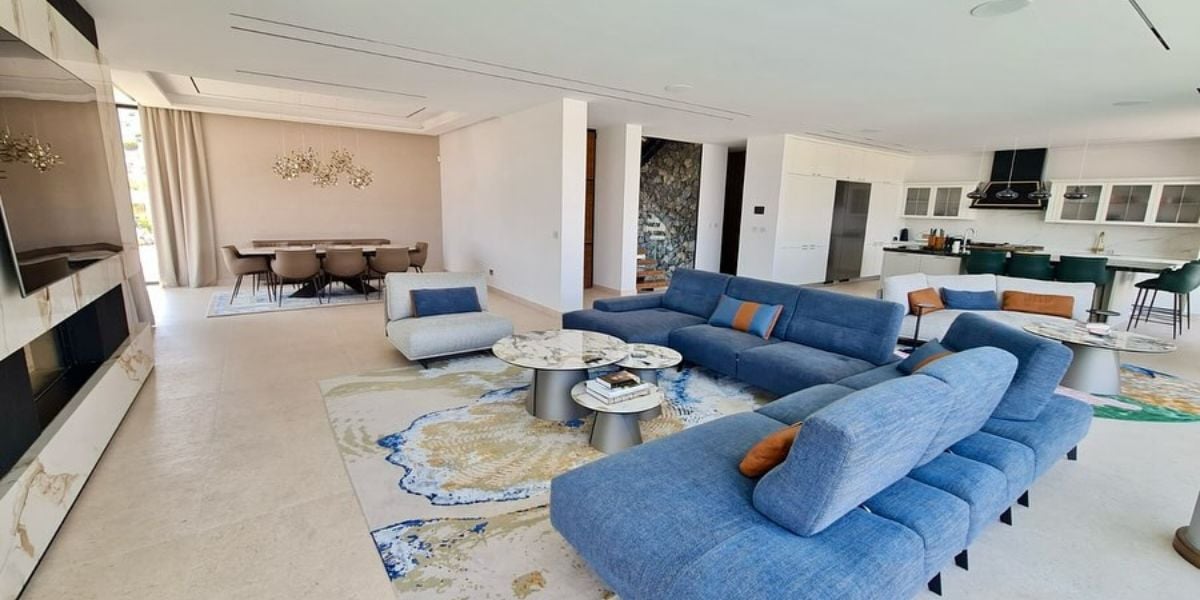
One of the most challenging versions of open plan living is when you have three or more zones - the most common arrangements include sitting, dining and cooking areas. Smartly planned and it can work out extraordinarily but if not, it just looks like a very large room with a lost fridge in it.
This Cyprus Villa project by my colleague Sanjay Joshi shows the perfect arrangement of not just the furniture, but the scale of the furniture, the placement of the rug and just every detail. The whole living zone is anchored by a generous size sectional sofa, customised in a strong mid-blue shade - not neutral, deliberately of course.
And then the sofa is anchored by a bespoke rug, designed specifically for this space and this sofa and they work together to mark this space as the primary destination while everything else including the kitchen are supporting cast. And while this area was specifically to enjoy the beautifully done fireplace TV unit, our client also wanted an additional sitting area to relax and look out onto the pool and the beautiful views surrounding this home.
So naturally, a curved sofa was added with a round coffee table and rug, adding a softness to the room while marking it distinctly from the main seating area.
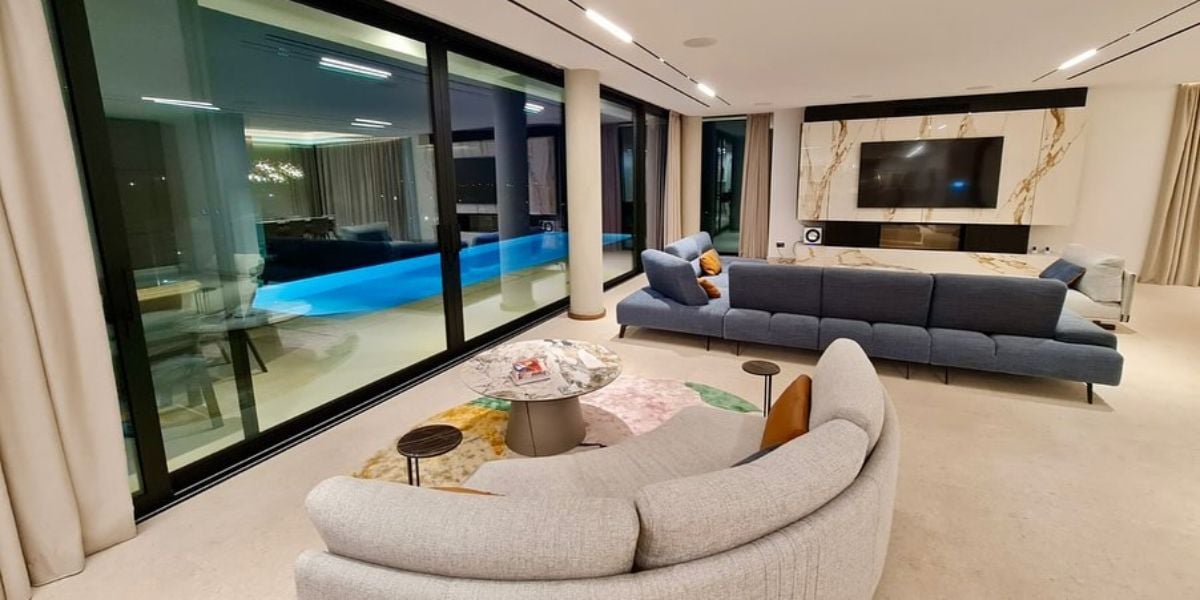
Once again, the bespoke rug is doing some serious work here. In triple and tetra-zone layours, continous flooring can often disturb the hierarchy of the spaces. On the other hand, using different sizes and shapes of rugs within that same room makes the room make sense by sort of creating a room within a room - without the walls of course. You'll also note that both the rugs in this space were abstract in design bringing colour and movement to the room through their pattern. This allowed the rugs to ground the furniture rather than competing with it.
And then in the kithchen, we went with contrasting, green bar stools - a colour you won't really spot anywhere in the room. This technique is very useful in large open plan living rooms as we give every zone a distinct accent colour while staying within a coherent palette. The palette can be neutral, jewel tones, sunset or anything else you prefer but it helps the eye and the mind understand where one zone ends and the other one begins - without any physical walls in place.
Key Takeaway: In a triple or tetra zone open plan, the rug and accent colours are the main tools. Use them to get the right scale and position for the room to work effectively.
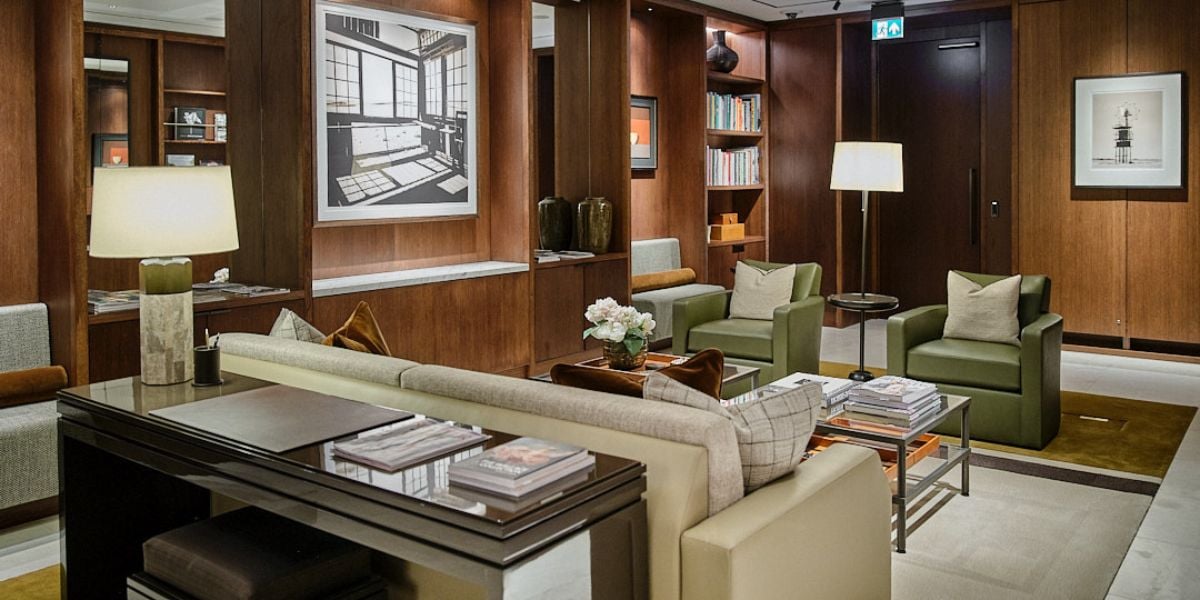
The brief for this project was quite an interesting one - make a library that doesn't feel like a boring library. The client wanted an open plan space that integrated a small seating area with a bookshelf and a study table. So the solution was to go for a floor to ceiling fitted bookshelf with integrated shelving and a small seating area, a cosy seating area and a small, low profile writing table with a pouf - keeping everything balanced with precision.
One of the main highlights of this space is the walnut colour which has been used for material continuity throughout. The same panelling runs on the wall as the bookshelf and earthy colours have been selected for the rest of the furniture to make the whole room feel cohesive. When it comes to accessories, lighting and artwork have been used very subtly but cleverly in this space to ensure it complements the joinery and doesn't overshadow it.
Key Takeaway: A library-lounge succeeds when the joinery does the zoning. Full-height panelling with integrated storage unifies the room while the furniture choice and colour distinguishes the activities within it.
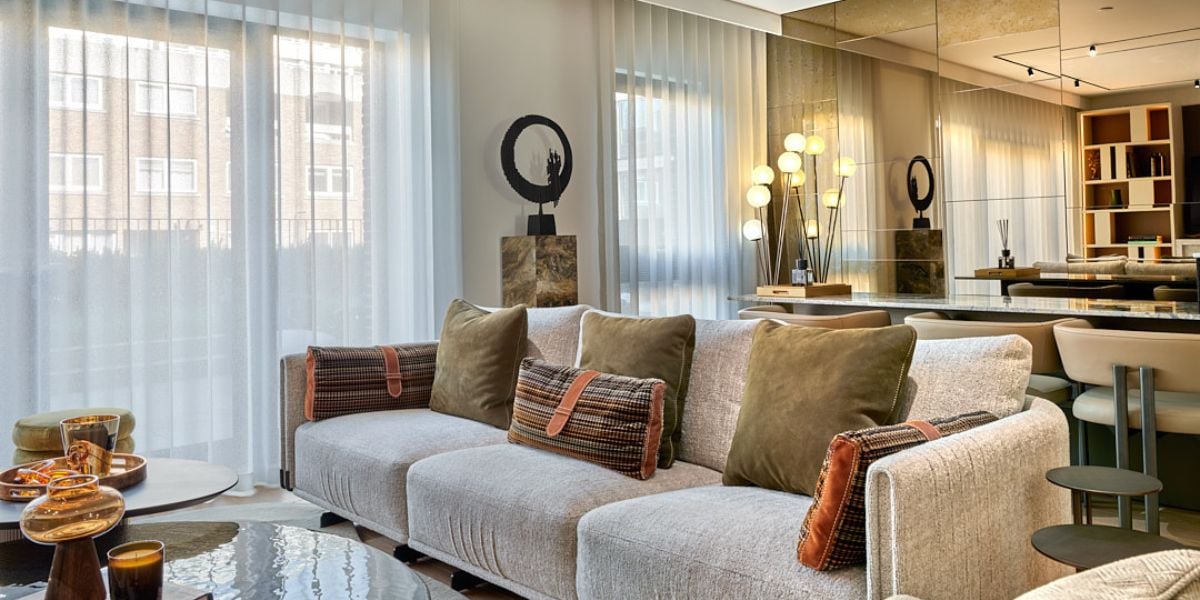
This is one of the oldest tricks in the book but it continues to work amazingly for small rooms. Designed by our frequent trade client, Rita from DownTownInteriors, and furnished by FCI London - the full width mirror plan doubles the apparent depth of this room while beautifully reflecting the light coming in from the opposite window - making the room feel very lively and active, no matter which angle you look from. The characteristic smoky finish and variation in the mirror instead of a simple clear glass also makes it feel perfect for a living room. We deliberately went for a restrained sofa here in a natural, textured weave, clean lines and no patterns. Because the mirror is the primary highlight of the room and the furniture needs to support it.
Another favourite feature of mine in this room is the sheer, floor to ceiling curtains which blurs the distinction between the outside and the inside - making the room feel softer and welcoming.
Key Takeaway: A full-width mirror panel is one of the most effective tools in a small open plan. It earns its place not just through reflection, but through the sense of layered depth it introduces to a scheme.
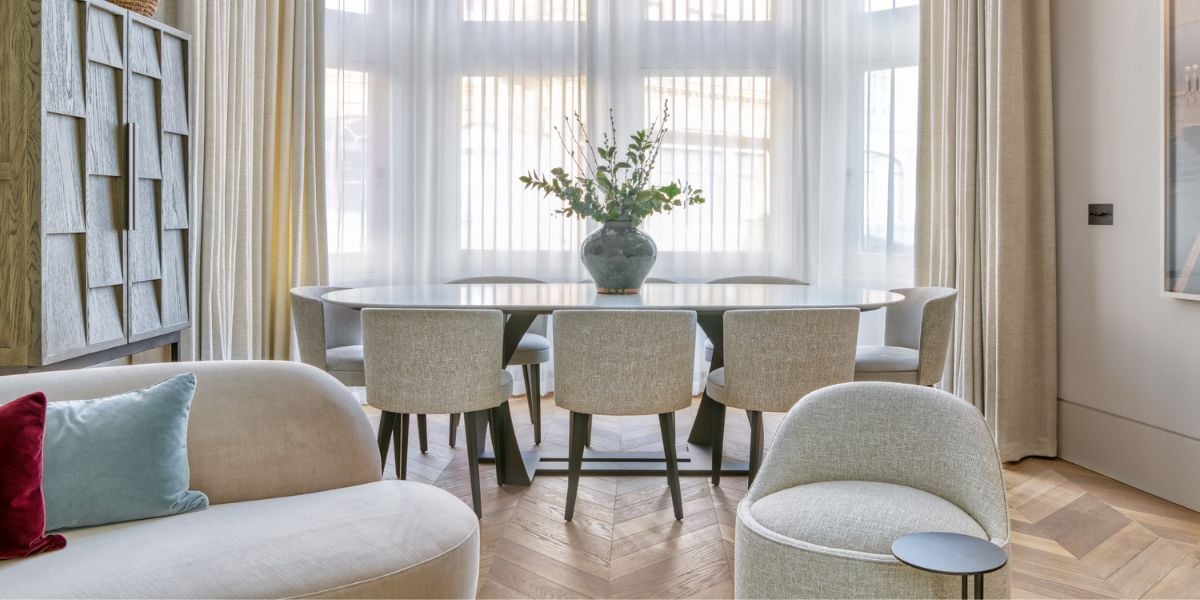
This is another example of a smaller open plan living space, designed by Fabio Dovico Lupo - this room combines living and dining in a way that every piece of furniture is visible from every part of the room and in such cases, furniture needs to be chosen carefully. The ocal dining table was chosen to bring softness as a rectangular one would have felt rigid in this space. It also improves the circulation around the table - when paired with round armchairs, it creates a considered space instead of a compromised one.
Then for the sofa and armchairs too, we went with curved pieces and round side tables in proportions that are perfect for this space and don't block anything.
Key Takeaway: In a compact open plan, the floor is your most powerful design tool which can be further complemented with curved furniture.
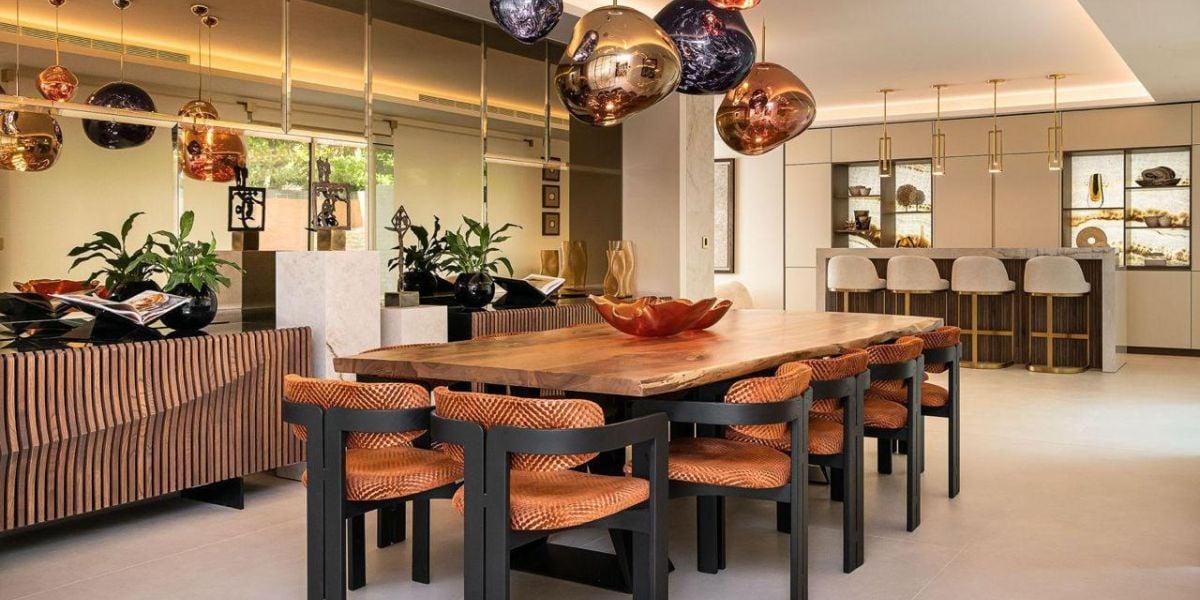
This project was a collaboration between our designer, Shahnaz and Jande Interiors - and the main highlight of this space was one piece of furniture - the live edge dining table with its beautiful, raw and unrefined feel. It operates as the anchor to this room, giving it all its warmth and personality. Another striking feature is the pendant lighting directly above the table. It features a series of globe pendants in copper, bronze and smoked tones at varying heights for visual movement above the table. In open plan spaces where we are not using rugs, pendant lightings are the best way of establishing zones.
The dining chairs are another interesting but confident choice here - the orange colour brings energy while the matte black structure lets the table shine. In the background you can see the bar seating which is in a completely different colour paletter to provide visual interest and also act as a transitional zone between the dining and cooking space. You'll notice that while we did not go for matching dining chairs and bar stools, the two still feel connected because of some common design elements and this makes them work beautifully.
Key Takeaway: When one piece of furniture is strong enough to anchor an entire zone, let it. A live-edge table with the right pendant cluster above it needs very little else to establish the dining area as a destination.
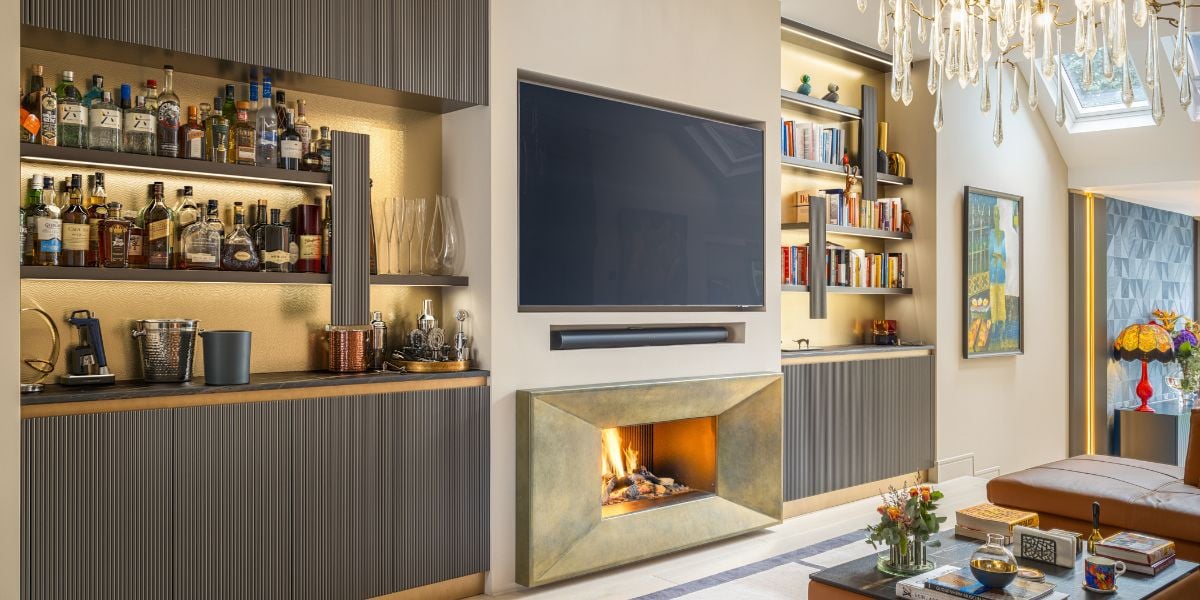
This project featured a very large open plan space with two seating areas and a dining area but the highlight here was the TV wall - featuring a builtin fireplace, ribbed dark joinery, a bar unit and a bookshelf. The bespoke joinery was the key decision here where the fluted cabinetry brought an interesting texture across the whole space. Overhead, you'll see some beautiful crystal chandeliers that prevent the scheme from feeling oppressive.
Key Takeaway: An integrated home bar only works when the joinery design is resolved from the start. A bar that reads as a piece of furniture placed against a wall will always feel provisional. One built into the architecture of the room is a permanent and genuinely rather pleasing thing.
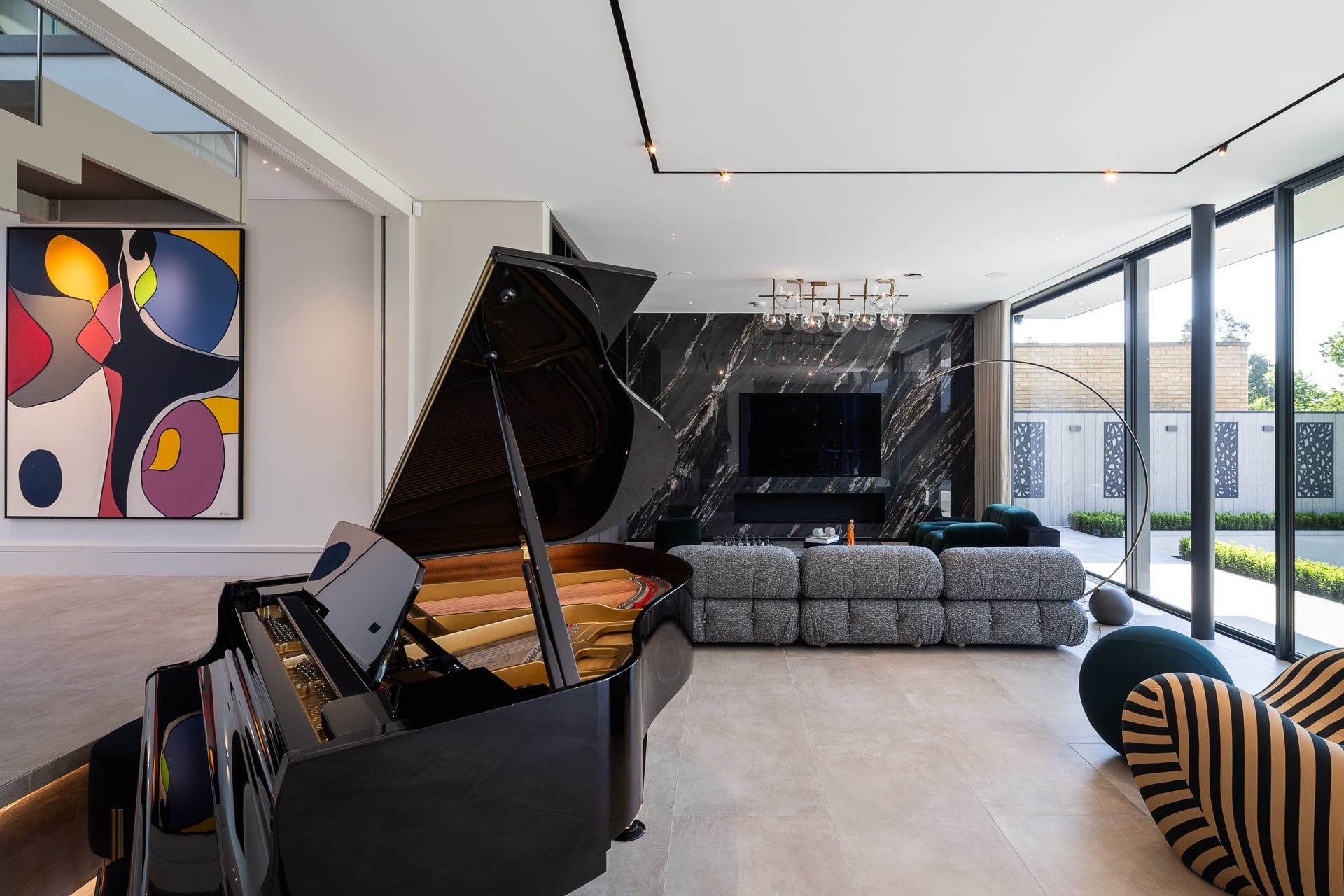
Some open plan spaces are built around the zones and then there are projects where a client wants the whole room around one object - this project is obviously in the latter category. The grand piano was the main feature that the client wanted to keep and the whole space was designed around it. One one side of the piano, we have the beautiful living room, once again, with a fireplace TV unit and bespoke joinery while on the other side we have a kitchen and dining area.
Of course you don't really need a grand piano for this idea to work - it will work equally well with an accent armchair or a bookshelf - anything that brings life to the room. The key is to look for contrast and drama while breaking up the zones.
Key Takeaway: If a client owns a statement object - a grand piano, a significant sculpture, an extraordinary piece of furniture - design the room around it rather than alongside it. The result is invariably more coherent and more personal than a room where no single element is allowed to lead.
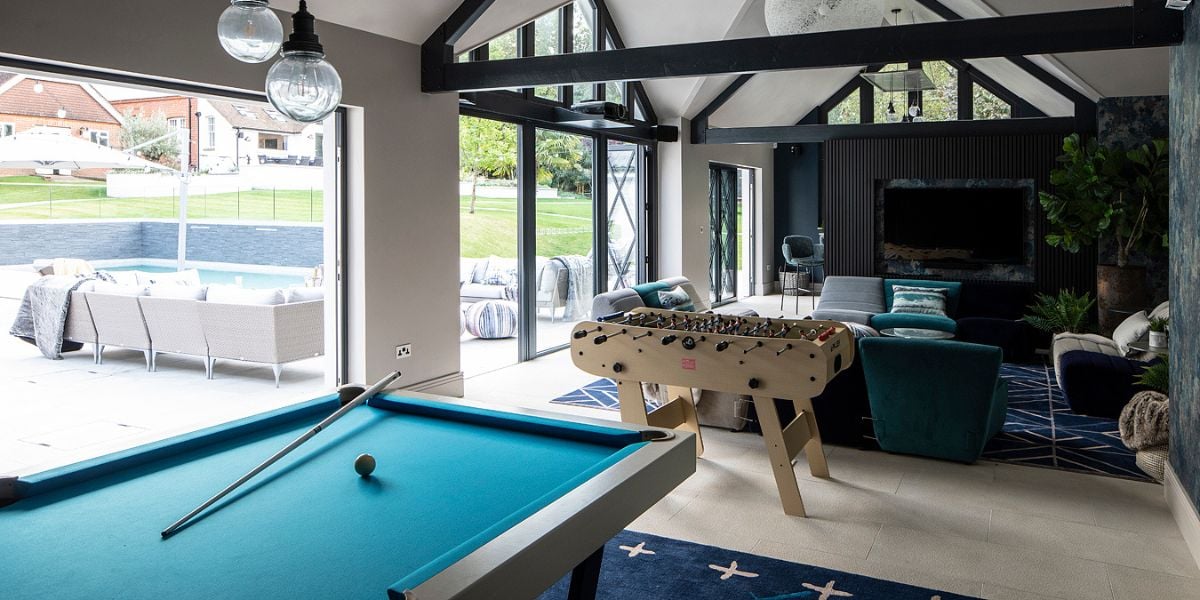
This project is from a vacation home that we furnished for a client in collaboration with Rina Vastu. This one features a dedicated game room as part of the wider open plan living arrangement, connected to both the interior and the outdoor space. It is supposed to be more than just a comfortable living space. So the natural decision was to go for modular sofas that can be moved around to suit the gaming session on the TV. Then both the living room and the foosball and snooker area are connected through rugs in same colour scheme but different designs. Blue is really the connecting colour in this whole villa - from the pool outdoors to the living room and the kitchen - different shades of blue connect the whole scheme together.
Key Takeaway: A vaulted ceiling is to a games room what herringbone is to a small living space - the single architectural move that lifts the entire scheme. Without the ceiling, this is a room with a pool table. With it, it is a room worth spending time in.
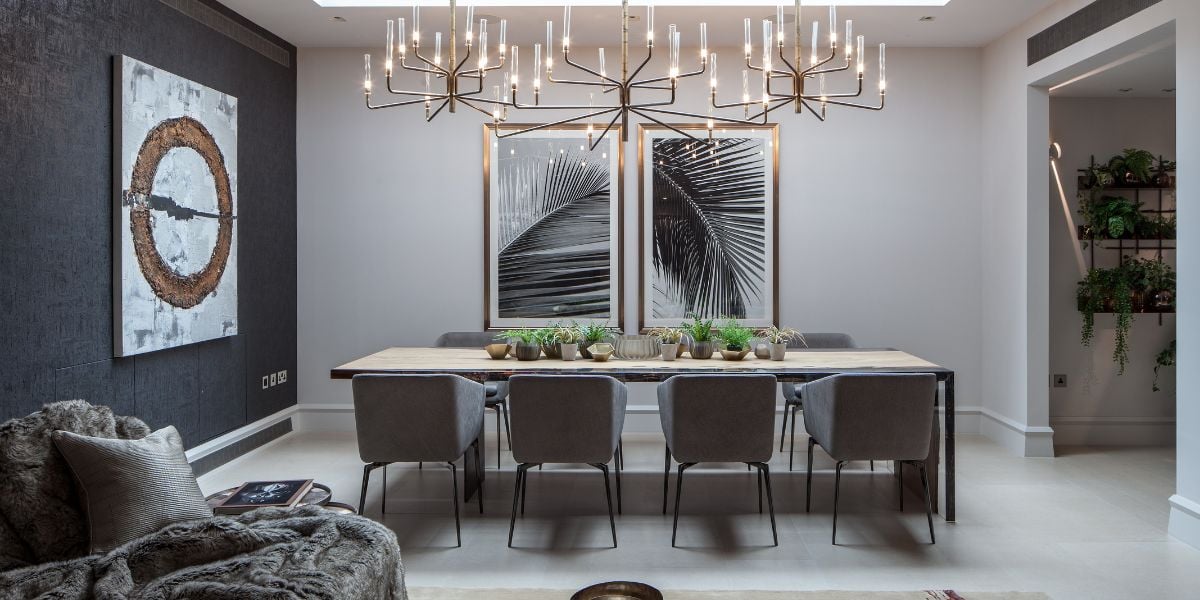
Of all the spaces we have shortlisted for today, this one is the best example of using lighting as a zoning tool. The chandelier here is not an afterthought - it is a boundary marker that connects the skylight above with the dining table underneath and marks this space separately from the rest of the room - giving a clear signal that this is the place to eat. The subtle use of natural elements is also very cleverly used here, the branch life chandelier, the small planters on the table and the leaf art on display on the wall create a mesmerising effect altogether.
Key Takeaway: In an open plan space without walls, lighting is a powerful zoning tool. A chandelier that is sized to match the dining table below creates a boundary zone from the ceiling plane - no partition, no level change, no material shift needed.
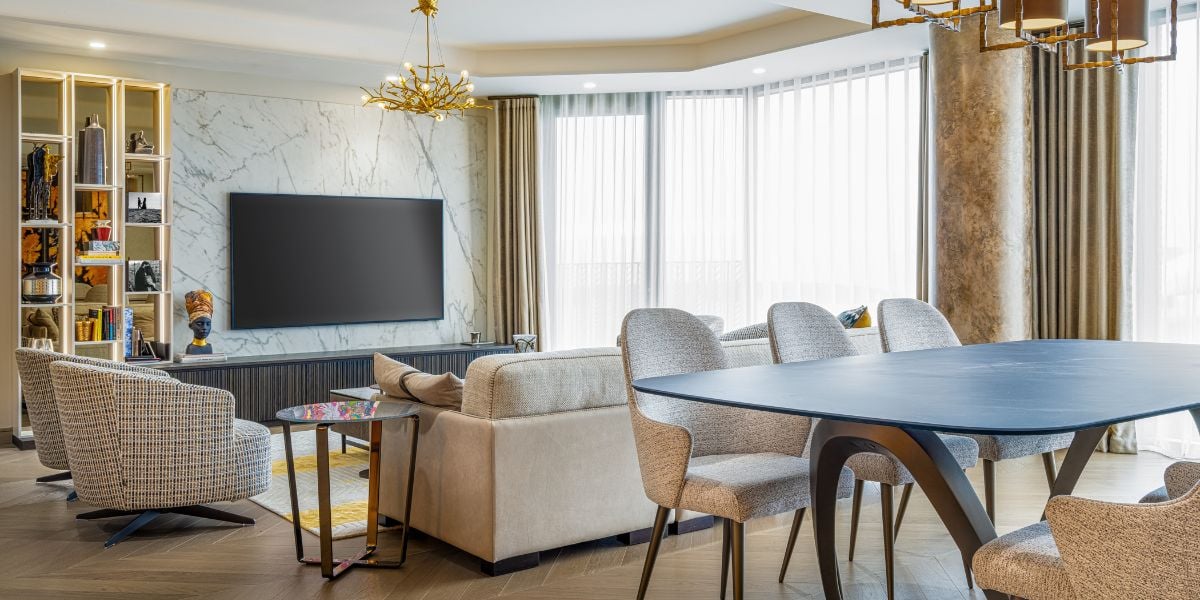
This project is instructive because it demonstrates how a coherent material palette can unify an open plan space more effectively than any amount of spatial planning. The brief here was for a living and dining room that felt luxurious without feeling formal - a balance that is genuinely difficult to achieve and that this project handles rather well.
The Calacatta marble feature wall anchors the TV and media unit at the far end of the living zone. Marble at this scale is a significant commitment - it dominates the room's chromatic identity and sets a quality benchmark that everything else must meet. The grey and gold veining in the stone is picked up in the brass-toned chandelier above the dining table, which creates a material dialogue between the two ends of the room. This is the technique at the heart of material-led design: selecting primary surfaces that contain enough tonal and chromatic variation to generate the palette for the entire scheme.
The herringbone timber floor provides warmth at ground level that the marble and painted walls do not. Without it, the room would read as cool and somewhat clinical. The herringbone also introduces directionality - it draws the eye from the living zone toward the dining area, which helps establish the sequential relationship between the two spaces in a room where there is no physical threshold between them.
The oval blue dining table is the most unexpected element in an otherwise restrained palette, and it is entirely the right call. A touch of saturated colour in a material-led scheme provides relief and personality. The blue is deep enough to read as a serious design choice rather than an accent piece, and the oval form echoes the rounded upholstered chairs around it with pleasing consistency.
Key Takeaway: In a material-led open plan scheme, choose your primary surface first and let it generate the palette. A marble feature wall with sufficient tonal variation can inform the metalwork, the upholstery and the accent colours across the entire floor plan.
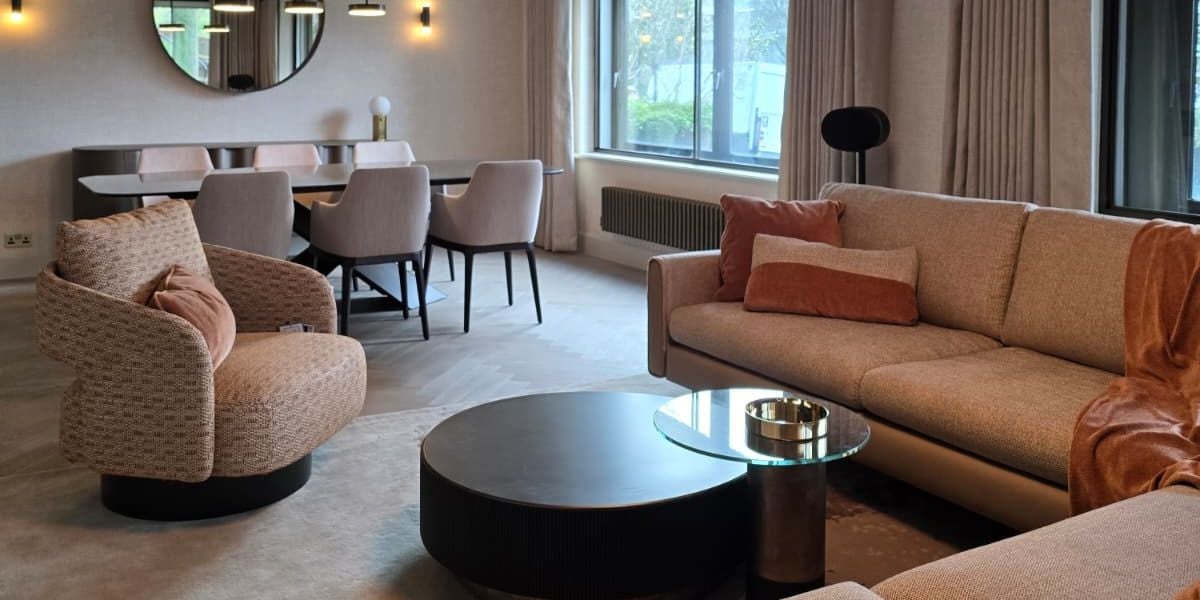
Not every open plan living idea needs to be a statement. This project makes the case for warmth, curves and restraint as a perfectly coherent design position - one that is, in its quiet way, rather harder to achieve than any of the more dramatic schemes in this collection.
The palette is built entirely from warm neutrals: sand, caramel, terracotta, warm grey. There is no cool tone anywhere in the room. This is a deliberate and disciplined choice that gives the space an enveloping quality - it feels genuinely comfortable in a way that more chromatic schemes sometimes do not. The orange cushions on the sofa are the only moment of chromatic emphasis, and they are warm enough to sit within the palette rather than contrasting with it.
The curves are consistent throughout. The armchair has rounded arms and a curved back. The coffee tables - one low drum form, one cylinder - introduce circular geometry at ground level. Even the dining chairs visible in the background share the rounded, generously proportioned character of the foreground seating. This formal consistency across different furniture typologies is what distinguishes a considered scheme from a well-intentioned one.
The coffee table pairing deserves particular attention. A single large round table would have been the obvious choice, and the less interesting one. Two tables of different heights and diameters creates visual layering and practical flexibility - different surfaces at different heights for different uses. It is a small decision with a disproportionate effect on the sense of considered composition within the living zone.
The dining arrangement visible behind is kept deliberately simple, which is the right call. In an open plan living room where the seating zone has strong character, the dining area should complement rather than compete. Dark dining chairs against a pale background provide definition without drama.
Key Takeaway: A warm neutral palette with consistent curves is one of the most liveable open plan approaches available - and one of the most underestimated. The discipline required to commit to it fully, without introducing a single cool tone or hard edge, is considerable. The result, when executed well, is a room that is genuinely difficult to leave.
What is open plan living?
Open plan living refers to a layout in which two or more traditionally separate rooms - most commonly a living room, dining room and kitchen - share a single uninterrupted floor area, without dividing walls between them. The arrangement encourages a more social, connected way of living, with cooking, dining and relaxing all happening within the same shared volume. The challenge, and the opportunity, lies in giving each activity its own identity within that shared space through furniture placement, lighting, materials and rugs rather than physical partitions.
Is open plan living still popular?
Yes - and for good reason. Open plan living remains one of the most consistently requested layouts among the clients we work with, particularly in larger homes and renovations where removing a wall is structurally straightforward. What has shifted is how it is approached. The open plan schemes that are genuinely worth living in are the ones where zoning is resolved with intention - where a rug, a chandelier or a material change does the work that a wall used to do. The format itself is not going anywhere; the desire to do it more thoughtfully is, if anything, growing.
How do you divide an open plan living room?
Without resorting to partition walls, the most effective tools are rugs, lighting, furniture orientation and changes in material or ceiling height. A large rug under the seating group defines the living zone clearly enough that no wall is required. A pendant or chandelier scaled to the dining table signals the dining zone from the ceiling plane downward. A sofa positioned with its back to the dining area creates a soft visual boundary between the two. In more ambitious schemes, a change of floor material, a step up or down, or a run of low-level joinery can establish zone separation with considerably more architectural conviction.
How do you zone an open plan living room without using walls or partitions?
Rugs, lighting and furniture orientation are the three most reliable tools. A rug under the seating group defines the living zone; a pendant or chandelier scaled to match the dining table defines the dining zone; the direction a sofa faces establishes where one area ends and another begins. In the projects shown here, not one zone boundary is created by a physical partition - all of them are established through furniture, light and material.
What flooring works best in an open plan living space?
A continuous floor surface throughout the open plan is almost always the correct decision - it unifies the space and avoids the visual interruption of threshold strips. Herringbone timber is a particularly strong choice because it introduces warmth, directionality and visual interest without requiring pattern changes between zones. Stone and large-format porcelain both work well where a cooler, more minimal aesthetic is required.
How do you make a large open plan room feel cosy rather than cavernous?
Scale is the first consideration - furniture that is too small for the space will always make a large room feel empty and cold. Beyond scale, warmth comes from layering: textured upholstery, multiple light sources at different heights, rugs that define and enclose the seating zone, and materials that absorb rather than reflect light. The triple-zone and warm neutral projects in this collection both demonstrate this principle effectively.
Can a home office or study work within an open plan living space?
Yes, when the joinery design resolves the zoning from the outset. Full-height panelling with integrated storage creates a study zone that reads as part of the architecture rather than an intrusion into the living room. The key is to avoid placing a desk in a way that is visible from the primary seating group - positioning it perpendicular to or behind the sofa allows the two activities to coexist without either compromising the other.
Address & Hours:
FCI London, Rays House, North Circular Road, London, NW10 7XP
Monday - Saturday: 10am - 6pm
Sunday & Bank Holidays: 11am - 5pm
Contact Details:
Phone: +442081531235
Email: [email protected]
What to Bring:
Eleven open plan living ideas, eleven distinct design positions - and yet the same principles run through all of them. Zone with intention. Select materials that generate a palette rather than simply filling one. Let one element lead and arrange everything else in honest relation to it. If you are planning an open plan space and would like to talk through which approach suits your room, your brief and your way of living, visit us at FCI London or get in touch. We ask the right questions before we make any suggestions at all.
Donald McDowall-Wilson
"Very friendly and helpful staff, who were knowledgeable and went to a lot of effort to help us find exactly what we were looking for. The whole experience was excellent, from walking into the shop right up to receipt of the furniture. Highly recommended."
Jasveen Sawhney
"We had a large project and enjoyed every bit of the experience in selecting our furniture. Monika was amazing and very good at understand our spaces and our style. We were not satisfied until we found the right colours and combinations and both Monika and Saran were very patient and collaborative. Very pleased with the final result."
Joy Saleh
"A wonderful experience. Everyone was so friendly, accommodating and knowledgeable. From start to finish it was amazing. They listened, advised and delivered."
We help designers & clients transform mundane spaces into extraordinary ones.


Book a video consultation and we'll advise you on furniture, space planning, colour schemes and much more.
Book A ConsultationBook a visit to our stunning, multi award-winning, 30,000 sqft.
Over 700 brands under 1 roof.
Most Popular on FCI London: Fitted Wardrobes | Luxury Designer Rugs | Luxury Sofas | Luxury Furniture Store | Luxury Interior Designers | Luxury Bedroom Furniture | Luxury Modern Chairs | Luxury Coffee Tables | Luxury Designer Kitchens | Luxury TV Units | Luxury Dining Tables | Luxury Storage Solutions | Luxury Sideboards | Luxury Stools & Bar Stools | Luxury Bespoke Joinery | Luxury Modern Hallway Furniture | Furniture Showroom Appointment | Luxury Lighting | Modern Luxury Outdoor Furniture
Transparency isn’t a policy. It’s a principle.
Have a peek at what our clients really have to say.