
Published Date: Apr 13, 2026 | Last Updated: Jun 26, 2026
Written by: Emma Cyrus, Senior Copy, Content & Editorial Writer
Reviewed by: Shahnaz Hashim, Architectural Designer at FCI London
Edited by: Zoona Sikander, Head of Content
Estimated Reading Time: 6 minutes
TL;DR: The short answer is no - brown leather sofas are not out of style. The longer answer is that style was never really the right frame. A well-chosen brown leather sofa is one of those rare pieces that sits outside the trend cycle entirely. The question worth asking is not whether brown leather is fashionable right now, but whether you've found the right shade, the right silhouette, and the right maker. At FCI London, with 700+ brands and a comprehensive leather sample library, that conversation tends to go rather well.
.jpg)
Table of Contents
If you've already decided brown leather is the direction, this blog will help you choose, style, and maintain it with confidence. If you're still on the fence - perhaps a designer or architect working through options for a client - the history and versatility sections will give you the grounding to make the case. Either way, what you won't find here is a trend report dressed up as advice. Brown leather sofas have earned their place in serious interiors, and I'll show you exactly why.
Sofa trends come and go, but there's one question that has our clients genuinely divided: are brown leather sofas out of style?
It surfaces in our showroom more often than you might expect - from clients who love the look but worry it reads as dated, and from those who've always wanted one but talked themselves out of it. In my experience, the hesitation is almost never about the leather itself. It's about confidence - in the shade, in the pairing, in the commitment to something so quietly authoritative. This blog addresses all of it.
Furniture makers have been using leather for centuries, and its history in upholstery dates back to the 18th century, when it became the material of choice for high-end pieces - seen as more luxurious and durable than the alternatives available at the time.
One of the earliest and most enduring forms was the Chesterfield sofa: characterised by low backrests, rolled arms, and rich button-tufted upholstery. Brown was the natural default - neutral enough to work with almost anything, warm enough to anchor a room without dominating it.
What strikes me, having worked with these pieces for years, is how little the fundamentals have changed. The same qualities that made brown leather desirable in a Georgian drawing room - its depth, its adaptability, its ability to age beautifully - are precisely what clients respond to today, whether the setting is traditional or thoroughly contemporary.
Key Takeaway: The Chesterfield has been in continuous production for roughly three centuries. That is not a trend - that is a canon. Any piece with that kind of provenance is worth understanding on its own terms, not through the lens of what happened to be fashionable last season.
One of the things I find myself returning to with clients is how well brown leather travels across different interior styles. It sits as naturally in a more traditional setting - alongside dark wood, aged brass, heavy curtains - as it does in a pared-back contemporary scheme where it provides warmth against cooler surfaces like concrete or brushed steel.
The range of silhouettes available makes it equally flexible.
I've specified sleek, low-profile designs for clients who want the material without any sense of heritage weight, and more sculptural pieces with tufted backs for those who want the full effect. The Karl Sofa by Gamma & Dandy is a particularly good example of how a contemporary form and classic leather coexist without compromise - it comes in various sizes, which is rather helpful for rooms where proportion matters.
What most clients don't realise until they're standing in our sample room is just how wide the brown spectrum actually is.
There is cognac - warm, amber-tinted, almost honeyed. There is tobacco - richer, denser, with a slight red undertone that deepens beautifully in low light. There is saddle - the classic mid-brown that reads as effortlessly timeless regardless of what surrounds it. And there is espresso, which sits so close to black that it anchors a room with real authority.
Every sofa in our collection can be specified in any shade from our leather sample library, which means the right tone for your interior genuinely exists - it's just a matter of finding it. It's also worth knowing that the leather will continue to evolve once it's in your home - if you're wondering do leather couches get softer over time, the answer is yes, and it's one of the more compelling arguments for choosing the material in the first place.
Key Takeaway: "Brown leather" is not a single decision - it is the beginning of a rather interesting one. The shade you choose will do more to determine how the sofa reads in a room than almost any other variable, including size or silhouette. It's worth taking the time to look at samples in your actual light conditions before committing.
In my experience, a brown leather sofa works best when it's treated as the anchor of the room rather than one element among many. It has a quiet authority that rewards restraint in the surrounding arrangement - the pieces around it should frame it, not compete with it.
Here are the principles I return to most often when helping clients style one well.
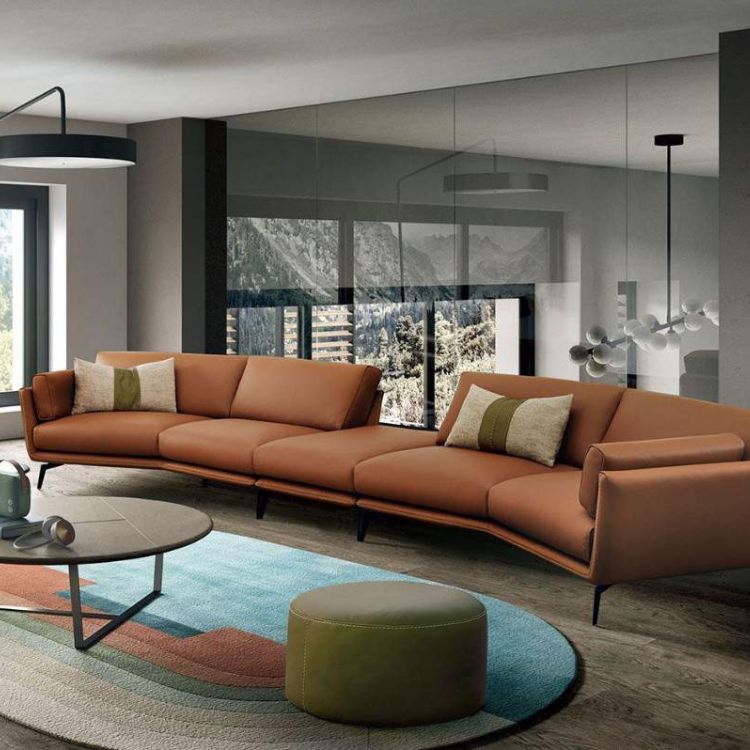
The rich depth of brown leather works well with warm neutrals - cream, aged linen, soft stone, or a warm grey. These don't fight the leather; they let it lead. For clients who want more visual interest, a considered accent colour introduced through cushions or a rug can be quite extraordinary - but I'd always encourage pulling that colour from somewhere already present in the leather's own undertone rather than adding something entirely new.
One trick I always use with clients is to pull a secondary tone from the leather itself - if the sofa has a warm red undertone, a deep terracotta cushion will feel entirely intentional rather than merely coordinated. It's the difference between a room that matches and one that actually coheres.
Incorporate different textures to create depth and interest in the room. Consider adding a soft wool or faux fur throw blanket, a woven basket, or a textured rug.
Leather is at its most compelling when it has something genuinely tactile to play against. A smooth sofa in a smooth room is just furniture. Set it against a hand-knotted rug and a raw linen cushion, and it becomes a composition - and that distinction is rather the whole point at this level.
Don't be afraid to mix different fabrics and materials. A velvet or linen armchair alongside the leather sofa works beautifully, as does a patterned throw pillow that breaks up the solid surface. If you're still weighing up the material decision itself, our guide to leather vs. fabric sofas covers the practical and aesthetic arguments in full.
The clients who get this most right are the ones who stop thinking about "matching" entirely. A tobacco leather sofa alongside a sage velvet armchair should not match - it should belong together, which is a different and more interesting thing.
When I want to use a sofa as a genuine focal point, placement matters as much as the piece itself. The Saks Sofa by Gamma & Dandy, positioned centrally with considered space around it, does this particularly well - the depth of its earth tone commands attention without needing embellishment. A gallery wall, statement lighting, or a large piece of artwork in the surrounding arrangement will reinforce the sofa's position rather than distract from it.
A sofa earns its place as a focal point by being confident enough to hold the room without assistance. Brown leather - particularly in a deeper shade - has that quality. The surrounding pieces need only to frame it, not compete with it.
.jpg)
Having spent 40 years curating a collection of luxury bespoke furniture at FCI, I've seen what separates pieces that age beautifully from those that don't - and it almost always comes down to consistency of care rather than any single product or treatment. Here is what I recommend:
Key Takeaway: Good leather ages well precisely because it responds to care rather than resisting it. The clients whose sofas look extraordinary after ten years are almost always the ones who conditioned consistently and cleaned promptly - not the ones who invested in a protective spray and forgot about it. If you'd like to go further, we've also written on how to make leather sofas more comfortable over time - well worth a read once your piece is in situ.
Can I order a brown leather sofa in a specific shade through FCI London?
Yes - and this is one of the more useful things about working with us directly. Every sofa in our collection can be specified in a shade of your choosing from our leather sample library, which spans everything from pale sand and warm cognac through to deep tobacco and near-black espresso. I always recommend viewing samples in your own lighting conditions before deciding - the same leather can read quite differently in a north-facing room versus one with afternoon sun.
Will a brown leather sofa date my interior?
Quite the opposite, in my experience. The pieces that date quickly tend to be the ones chasing a particular moment - an on-trend fabric, a fashionable silhouette. Brown leather, particularly in a classic form, sits outside that cycle. What matters far more is whether the rest of the room has been considered with the same level of care. A thoughtfully composed interior with a brown leather sofa at its centre will look deliberate in twenty years. A poorly considered one with a beige linen sofa will look dated in five.
How does brown leather work in a contemporary interior scheme?
Rather well, when the shade is right. In a contemporary interior - clean lines, restrained palette, considered materials - a deeper tone like tobacco or espresso tends to work best. It reads as intentional rather than inherited. In schemes with more warmth or natural material - oak, stone, linen - a cognac or saddle leather will feel genuinely at home without looking as though it has simply been placed there. The Karl Sofa by Gamma & Dandy is a refreshingly competent example of exactly this.
How long should a quality leather sofa last?
A well-made piece from a reputable maker, cared for consistently, should last comfortably between 15 and 25 years - often considerably longer. The leather itself tends to improve with age, developing a patina that adds character rather than diminishing it. This is one of the qualities that distinguishes a genuinely high-quality hide from a corrected or bonded leather, which is why provenance and maker matter so much at this level. The pieces we source at FCI are selected with longevity as a non-negotiable.
Visit Our Showroom
Address & Hours:
FCI London, Rays House, North Circular Road, London, NW10 7XP
Monday - Saturday: 10am - 6pm
Sunday & Bank Holidays: 11am - 5pm
Contact Details:
Phone: +442081531235
Email: [email protected]
What to Bring:
Brown leather sofas were never really in danger of going out of style - they were just waiting for the right clients to stop second-guessing them. Whether you're drawn to a warm cognac or the quiet authority of deep espresso, the right shade and the right piece exist within our collection. If you find yourself pulled toward the darker end of the spectrum, it's also worth exploring our guide to black leather sofas - a natural next step for anyone considering a more dramatic anchor piece. Come and see us at the showroom, or get in touch - the sample library alone tends to settle the matter rather quickly.
Customer Reviews
Zlata Rybchenko (Customer)
"I had an excellent experience with FCI. Their showroom offers an impressive selection of high-quality furniture and top international brands. The team provided outstanding service - knowledgeable, attentive, and genuinely helpful."
Linda Nobilio (Customer)
"We had inbuilt furniture done in three bedrooms by FCI London and honestly, we couldn't be happier with the results. The quality of their work is just next level. The furniture is solid, beautifully made."
Elisa Foppa (Customer)
"A true one-stop shop for elegant Italian design. It's rare to find such a well-curated selection all in one place in North London. The team are knowledgeable and happy to advise, while still giving you space to browse at your own pace."
We help designers & clients transform mundane spaces into extraordinary ones.


Book a video consultation and we'll advise you on furniture, space planning, colour schemes and much more.
Book A ConsultationBook a visit to our stunning, multi award-winning, 30,000 sqft.
Over 700 brands under 1 roof.



Most Popular on FCI London: Fitted Wardrobes | Luxury Designer Rugs | Luxury Sofas | Luxury Furniture Store | Luxury Interior Designers | Luxury Bedroom Furniture | Luxury Modern Chairs | Luxury Coffee Tables | Luxury Designer Kitchens | Luxury TV Units | Luxury Dining Tables | Luxury Storage Solutions | Luxury Sideboards | Luxury Stools & Bar Stools | Luxury Bespoke Joinery | Luxury Modern Hallway Furniture | Furniture Showroom Appointment | Luxury Lighting | Modern Luxury Outdoor Furniture
Transparency isn’t a policy. It’s a principle.
Have a peek at what our clients really have to say.