
Published Date: Jul 06, 2026
Written by: Emma Cyrus, Senior Copy, Content & Editorial Writer
Reviewed by: Mansi Gokani, Interior Designer at FCI London
Edited by: Zoona Sikander, Head of Content
Estimated Reading Time: 13 minutes
TL;DR: The best bedroom lighting ideas layer ambient, task and accent sources rather than relying on one central fitting. Ceiling height, room size and how you actually use the space determine which fixtures work, from statement pendants in period properties to flush mounts in low-ceiling flats. This blog covers the three-layer framework, the 5-7 lighting rule, and modern bedroom lighting ideas suited to small bedrooms, master suites and everything in between, plus the European fixtures genuinely worth the investment.
Table of Contents
If you're renovating a period property in London and want bedroom lighting ideas that respect generous ceiling heights without pastiche, this blog is for you. Owners of newer builds seeking small bedroom lighting ideas or considered master bedroom lighting ideas will also find these principles rather useful. We've drawn on fifteen years of client installations to set out layering strategies that actually work. When only genuinely considered lighting will do, these solutions deliver the atmosphere your bedroom deserves.
Most bedroom lighting ideas you'll find online stop at mood boards and product carousels.
Beautiful, yes.
Useful for an actual installation? Rarely.
After fifteen years advising clients across London, I've learned that exceptional bedroom lighting isn't about following trends. It's about understanding how light behaves in your specific space, then building a system that serves every moment from dawn reading to late-night unwinding.
At FCI London, we approach luxury lighting with an eye for enduring quality, an understanding of how people actually live, and a refusal to compromise on craftsmanship. The difference between adequate lighting and transformative lighting often comes down to three things: proper layering, fixture quality, and knowing which rules to follow (and which to ignore).
The best lighting for a bedroom combines ambient (general illumination), task (reading, dressing), and accent (decorative or mood) layers, each controlled independently and scaled to the room's proportions and ceiling height. This three-layer framework allows you to adjust lighting intensity and mood throughout the day, supporting both functional activities and restful atmosphere.
That's the technical answer. The real answer? It depends entirely on how you use the space.
Key Takeaway: There's no single fixture that answers this properly - layering is the actual mechanism, not a suggestion, and the mix will look different in every home we visit.
Ambient lighting provides overall illumination, typically from a ceiling fixture or recessed downlights. The goal is even, comfortable light without harsh shadows or clinical brightness.
Task lighting addresses specific activities: bedside reading lamps, vanity lighting, wardrobe illumination. These fixtures need sufficient output (we recommend 400-500 lux for reading) but shouldn't flood the entire room when your partner is trying to sleep.
Accent lighting adds depth and atmosphere through picture lights, LED strips behind headboards, or wall sconces used at low intensity. This layer does the least functional work but contributes most to the room's character.
Most homeowners install only the first layer, then wonder why their bedroom feels either too bright or too dim. The flexibility comes from having all three.
Key Takeaway: Ambient, task and accent aren't a checklist to tick off once - they're controls you'll adjust daily, so wire each layer independently from the outset.
Ceiling height fundamentally changes which fixtures will work.
In period properties with 3-metre-plus ceilings, you have the luxury of statement pendants and chandeliers. A 60cm fixture that would overwhelm a modern bedroom becomes perfectly proportioned. You can layer in wall sconces at 1.5-1.7 metres without creating visual clutter.
Contemporary flats with 2.3-2.4 metre ceilings demand a different approach. Anything that hangs more than 20cm below the ceiling plane starts to feel oppressive. Here, flush mounts, semi-flush fixtures, and recessed downlights preserve headroom while still delivering proper illumination.
We've seen too many expensive pendants installed in low-ceiling bedrooms, creating a constant sense of compression. Beautiful fixture, wrong application.
Key Takeaway: We treat bedroom lighting ideas ceiling height decisions as the first step, not an afterthought - and genuinely, most ceiling bedroom lighting ideas fail simply because the void or wall depth wasn't checked before ordering.
A single ceiling fixture, no matter how lovely, creates a lighting pattern that serves exactly one scenario: getting dressed in the middle of the room.
It doesn't help you read in bed (the light source is behind you, casting shadows). It doesn't create atmosphere (it's either on or off, no nuance). And it certainly doesn't accommodate two people with different schedules.
The central pendant has its place in the ambient layer. But it's the starting point, not the solution.
Key Takeaway: A pendant looks wonderful in photographs and does almost nothing for you at 11pm with a book in hand. Treat it as one layer among several, never the whole plan.
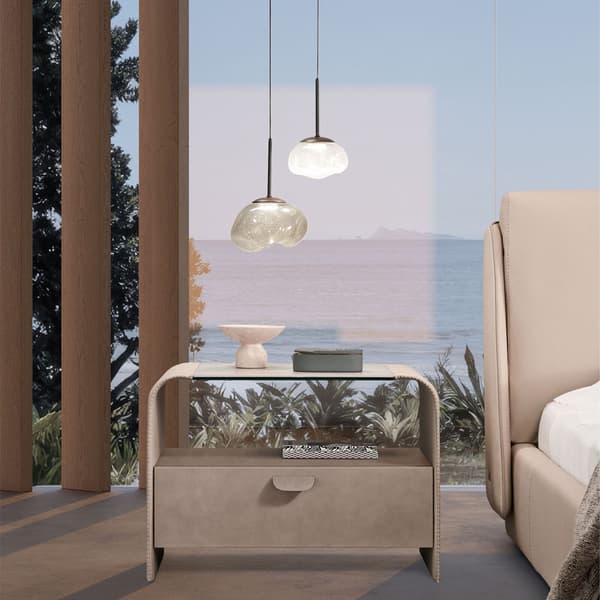
The 5-7 lighting rule states that a well-lit room should have five to seven light sources distributed across the three layers, ensuring balanced illumination without relying on any single fixture. This creates flexibility, depth, and the ability to adjust lighting for different times of day and activities.
For a typical bedroom, that might break down as: one or two ambient sources, two to four task sources (bedside lamps, vanity, wardrobe), and one to two accent sources.
Key Takeaway: Five to seven sources sounds like a lot until you count your own sitting room. Bedrooms deserve the same generosity, just dimmed appropriately.
Lux measures illumination intensity. Your bedroom needs different levels depending on the activity.
Morning preparation: 300-500 lux (bright enough to see colours accurately when dressing). Evening reading: 400-500 lux at the reading surface. Pre-sleep wind-down: 50-100 lux (warm accent lighting only). Night-time navigation: 5-10 lux (subtle path lighting or dimmable nightlights).
The mistake most people make is using the same light level for everything. Your circadian rhythm responds to light intensity and colour temperature. Bright, cool light (4000K+) in the evening suppresses melatonin production. Warm, dim light (2700K or lower) signals that it's time to wind down.
This is why independent control of each layer matters. You're not just adjusting brightness; you're supporting your body's natural rhythm.
Key Takeaway: Colour temperature matters as much as brightness here. If your evening lighting still reads as office-bright, no amount of layering will help you switch off.
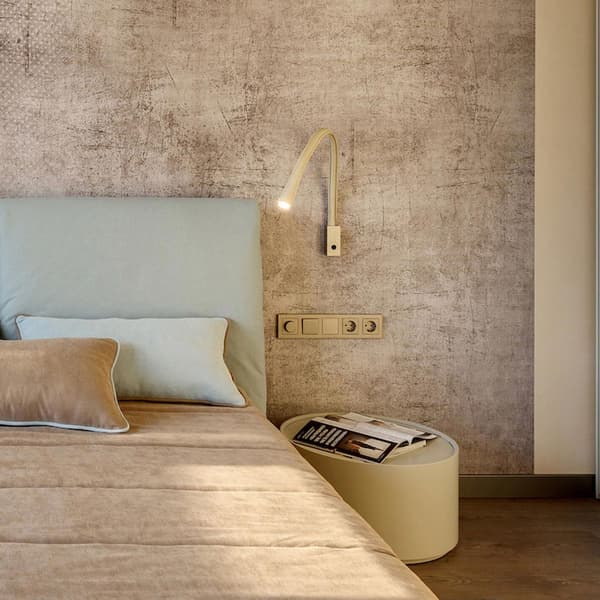
In a small bedroom (under 12 square metres), five sources might look like: one flush mount or pendant (ambient), two bedside lamps (task), one picture light or LED strip (accent), one wardrobe light (task).
In a master suite (20+ square metres), you might scale to seven or eight: recessed downlights on dimmers (ambient), bedside lamps (task), vanity lighting (task), walk-in wardrobe lighting (task), wall sconces flanking the bed (accent), LED tape under floating furniture (accent).
The principle remains the same. The execution scales to the space.
Key Takeaway: Scale the number of sources to the room, not the ambition. A cramped bedroom with eight fixtures is worse than a generous one with five well-chosen sources.
Key Takeaway: Room type, not room label, should drive your fixture choices - a "small" bedroom with 2.7 metre ceilings behaves very differently to a boxy new-build of the same footprint.
Flush mounts and semi-flush fixtures are your primary tools here. Look for designs with diffused glass or fabric shades that distribute light evenly without glare.
Recessed downlights work well if you're renovating and can accommodate the ceiling void (typically 100-150mm). Specify dimmable LED units with a warm colour temperature (2700-3000K). Space them 1.2-1.5 metres apart for even coverage.
Wall sconces become more important in low-ceiling rooms because they free up the ceiling plane entirely. Mount them 1.5-1.7 metres above the floor, roughly 60-75cm out from the bedside. This positions the light source at the correct height for reading without creating glare.
Skip: pendant lights that hang more than 20cm below the ceiling, chandeliers (unless exceptionally shallow), any fixture that draws the eye upward and emphasizes the low ceiling.
Here are some more low ceiling design tips to help you make the best of your space.
Key Takeaway: Every fixture you skip in a low-ceiling room is a favour to future you - wall-mounted sconces will always outperform pendants that eat into headroom.
In compact bedrooms, every fixture must justify its footprint.
Wall-mounted bedside lights eliminate the need for bedside tables (or at least reduce their size requirement), freeing up floor space. Swing-arm sconces offer adjustability without bulk.
Mirror-backed or reflective fixtures amplify light and create a sense of depth. A small pendant with a metallic interior finish does double duty: provides ambient light and reflects it back into the room.
LED strip lighting under the bed frame or behind a floating headboard adds dimension without consuming any physical space. It's pure atmosphere.
Avoid: table lamps that require surface area, floor lamps that claim corner space, oversized fixtures that dominate the room visually.
Key Takeaway: In tight bedrooms, a fixture earns its place twice: once for light, once for the space it doesn't take up. That's the real small bedroom lighting ideas test.
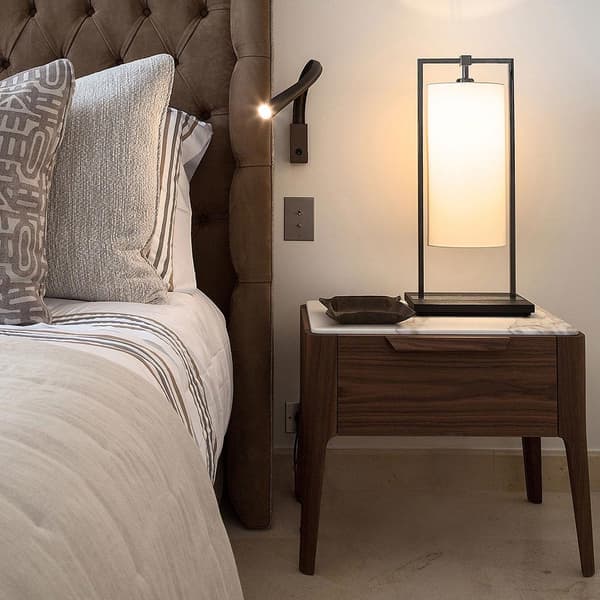
Larger bedrooms allow (and require) zoning. The sleeping area, dressing area, and seating area (if you have one) each need independent lighting.
Sleeping zone: bedside task lighting on individual switches or dimmers (so one person can read while the other sleeps), plus ambient lighting controlled from both the entrance and bedside.
Dressing zone: even, shadow-free illumination (recessed downlights or a linear fixture above the wardrobe), ideally on a separate circuit from the sleeping zone.
Seating or reading nook: a floor lamp or dedicated sconce, again independently controlled.
The goal is flexibility. Two people, different schedules, zero compromise.
Key Takeaway: Zoning a master suite properly means neither partner ever has to compromise on their own routine - which, frankly, is worth the extra circuit.
Key Takeaway: Trend-chasing and timeless design aren't opposites, but they do pull in different directions - know which one you're actually paying for.
Smart lighting in 2026 has matured past the gimmick phase. The useful applications: dimming from your phone when you're already in bed, scheduling lights to simulate sunrise, integrating with blackout blinds for a coordinated wake-up routine.
The gimmicks: colour-changing LEDs in a bedroom (unnecessary and disruptive to sleep), voice control that works 80% of the time (the 20% failure rate is maddening at midnight), app-based controls so complex they require a manual.
Our recommendation: install dimmable circuits with quality switches, then add smart bulbs or modules only where they genuinely simplify your routine. The infrastructure should work perfectly even if the smart system fails.
Key Takeaway: The best smart lighting is the kind you forget is smart. If you're troubleshooting an app at midnight, something's gone wrong with the brief.
Italian makers (Flos, Artemide) and Scandinavian brands (Louis Poulsen, &Tradition) consistently deliver fixtures that hold their value. The difference is in the materials (powder-coated aluminium instead of plastic, mouth-blown glass instead of moulded), the engineering (smooth dimming curves, accurate colour rendering), and the repairability (replacement parts available a decade later).
We've installed Cattelan Italia fixtures in clients' homes that are now fifteen years old and still look current. That's the definition of timeless.
Key Takeaway: Good bedroom light fitting ideas rarely come cheap, but the ones that last fifteen years without looking tired are worth every penny of the premium.
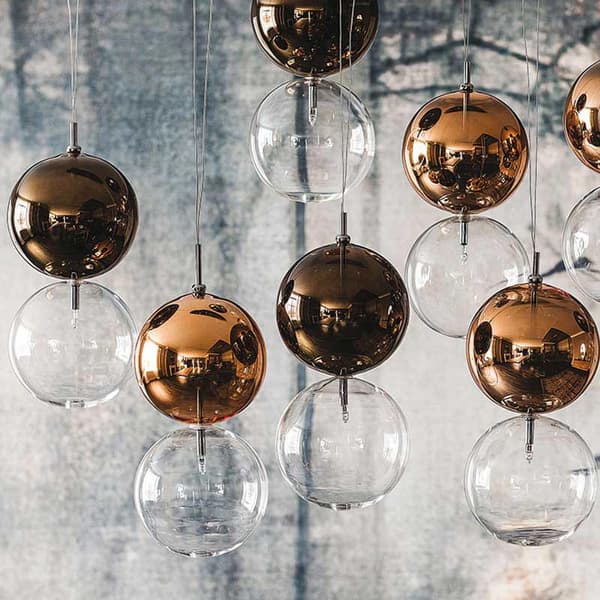
Certain designs transcend fashion: Arne Jacobsen's AJ lamp, Serge Mouille's wall sconces, anything from Gino Sarfatti's mid-century catalogue.
What they share: clean lines, honest materials, no unnecessary ornamentation. They were modern in 1955 and they're modern now.
When you're investing in bedroom lighting (and quality fixtures are an investment), choose designs that won't feel dated in five years. Trends come and go. Good design persists.
Key Takeaway: Buy the fixture you'll still want in a decade, not the one that photographs best this season - that's really the whole philosophy.
Q. What is the best lighting for a bedroom?
The best bedroom lighting combines ambient (general), task (reading, dressing), and accent (mood) layers on independent controls, scaled to your ceiling height and room size. Aim for five to seven sources total.
Q. What is the 5-7 lighting rule?
The 5-7 rule recommends five to seven light sources distributed across ambient, task, and accent layers to create balanced, flexible illumination. It prevents over-reliance on any single fixture and allows you to adjust lighting for different activities.
Q. How do I light a bedroom with low ceilings?
Use flush or semi-flush ceiling fixtures, recessed downlights (if ceiling void allows), and wall-mounted sconces instead of table lamps. Avoid pendants that hang below the ceiling plane. Keep the visual weight at the perimeter, not overhead.
Q. What are the latest trends in bedroom lighting?
In 2026, the focus is on circadian-friendly lighting (warm temperatures, dimmable), integrated smart controls (without complexity), and quality over novelty. Timeless European designs are displacing fast-trend fixtures.
Q. How do I light a small bedroom?
Wall-mounted bedside lights, reflective fixtures, and LED strip lighting maximize space. Every fixture must justify its footprint. Avoid table lamps and floor lamps that consume valuable surface area.
Q. How many lighting circuits does a well-lit bedroom actually need?
In our experience, three independent circuits (ambient, task and accent) cover almost every bedroom, however grand. Beyond that you're simply adding switches for the sake of it.
Q. Should bedside lamps match on both sides of the bed?
Not necessarily - and we'd argue mismatched task lighting is rather sensible if you and your partner read at different times or keep different hours. Match the scale and warmth of light, not the design.
Q. Which fixtures suit a low-ceiling bedroom?
The best bedroom lighting ideas low ceiling homeowners can rely on are flush mounts, recessed downlights and wall-mounted sconces kept close to the wall. Anything that hangs low will only draw attention to the ceiling you're trying to disguise.
Q. Is it worth rewiring an older bedroom for proper lighting layers?
Genuinely, yes, particularly if you're already renovating. Retrofitting circuits after decoration is always more disruptive - and more expensive - than wiring for the layers you actually want from the outset.
Address & Hours:
FCI London, Rays House, North Circular Road, London, NW10 7XP
Monday - Saturday: 10am - 6pm
Sunday & Bank Holidays: 11am - 5pm
Contact Details:
Phone: +442081531235
Email: [email protected]
What to Bring:
Exceptional bedroom lighting isn't about following a formula. It's about understanding the three-layer framework, then adapting it to your ceiling height, room proportions, and how you actually use the space.
The homes we return to years later (the ones that still feel right) are the ones where clients invested in quality fixtures, proper planning, and independent control of each lighting layer. No shortcuts, no compromises.
If you're planning a bedroom renovation or simply want to elevate an existing space, explore our curated lighting collections or speak with our design team. We work with clients across London and beyond who expect their homes to reflect the care and thought they put into every other aspect of their lives.
Get it right once. Enjoy it for decades.
"I had an excellent experience with FCI. Their showroom offers an impressive selection of high-quality furniture and top international brands. The team provided outstanding service - knowledgeable, attentive, and genuinely helpful."
Zlata Rybchenko
"Service was personalised and excellent. Sanjay saw us through the process from start to end ensuring that we were happy with our choices. The delivery guys were amazing and went the extra mile."
Chava Kahn
"Loved my experience with FCI. Kamil and Chrissy have been amazing and took care of me and my needs. Everything went smooth with my sofa bed order, an excellent piece of design delivered very quickly from Italy. Really recommend!"
Marzia Castelli
We help designers & clients transform mundane spaces into extraordinary ones.


Book a video consultation and we'll advise you on furniture, space planning, colour schemes and much more.
Book A ConsultationBook a visit to our stunning, multi award-winning, 30,000 sqft.
Over 700 brands under 1 roof.

Most Popular on FCI London: Fitted Wardrobes | Luxury Designer Rugs | Luxury Sofas | Luxury Furniture Store | Luxury Interior Designers | Luxury Bedroom Furniture | Luxury Modern Chairs | Luxury Coffee Tables | Luxury Designer Kitchens | Luxury TV Units | Luxury Dining Tables | Luxury Storage Solutions | Luxury Sideboards | Luxury Stools & Bar Stools | Luxury Bespoke Joinery | Luxury Modern Hallway Furniture | Furniture Showroom Appointment | Luxury Lighting | Modern Luxury Outdoor Furniture
Transparency isn’t a policy. It’s a principle.
Have a peek at what our clients really have to say.