
Published Date: Jun 06, 2026 | Last Updated: Jun 26, 2026
Written by: Emma Cyrus, Senior Copy, Content & Editorial Writer
Reviewed by: Benjamin Ibanez, Senior Interior Designer at FCI London
Edited by: Zoona Sikander, Head of Content
Estimated Reading Time: 8 minutes
TL;DR: Rattan dining sets had a good run - genuinely good, in fact. But the outdoor dining category has moved on, and those who designed their gardens in 2018 are noticing. Today's most considered exterior spaces favour woven rope over synthetic weave, solid teak and powder-coated aluminium over hollow tube frames, and a sculptural sensibility that holds up to the interior on the other side of the glass doors. This guide covers why rattan is being replaced, what the alternatives actually look like, and which pieces are worth serious consideration in 2026.
Table of Contents
If you're a design-conscious homeowner who spent the last decade looking at the same synthetic rattan dining set on every terrace from Surrey to Hampstead, this expert guide is for you. Interior design professionals sourcing considered outdoor pieces for clients will also find the material breakdowns and curated selections here invaluable. We've analysed the outdoor dining category in depth - from weave construction to teak provenance - to identify the pieces that genuinely deserve space in a refined exterior scheme.
For the better part of a decade, the rattan dining set was the default choice for anyone who wanted an outdoor space that felt considered without requiring too much thought. It arrived flat-packed, looked immediately at home on a terrace, and photographed well enough in interiors coverage that it felt almost design-led. Rattan dining chairs outdoor became shorthand for a certain kind of relaxed, sun-drenched aesthetic - somewhere between a Provencal farmhouse and a boutique hotel pool deck.
The appeal was straightforward. A rattan dining chair set of 4 or more, could be ordered online, delivered within days, and arranged around a glass-topped table with minimal effort. The weave texture gave the impression of natural material without the maintenance demands of actual rattan, and the relatively low price point meant it felt low-risk.
For many households, it was genuinely the right call at the time.
But outdoor living has matured considerably as a design category. Clients who invested in their interiors over the pandemic years - who specified Porada dining tables and Arketipo sofas for their reception rooms - started looking at their terraces with the same critical eye they applied indoors. And what they saw, in many cases, was a rattan dining set that looked increasingly provisional beside the standard they had reached inside.
The moment rattan is having right now is less a renaissance and more a reckoning. It is having a moment in the sense that people are thinking about it seriously - often for the first time - and asking whether it is still the right answer.
Key Takeaway: Rattan dominated outdoor dining for good reason - it was accessible, versatile, and low commitment. But as garden design has caught up with interior standards, the gap between what sits inside the house and what sits outside it has become harder to ignore. That gap is driving the category shift we're seeing in 2026.
The issue with most rattan dining chairs outdoor is not any single failing - it is a cumulative one. The synthetic PE rattan used in the vast majority of mass-market sets is a petroleum-derived product that, over several British winters, begins to show its limitations. It fades unevenly. It becomes brittle at the joints where the weave meets the frame. In colder temperatures, the material contracts in ways that loosen the weave pattern and, eventually, cause it to unravel at the edges.
The aluminium tube frames underneath are often thin-walled and lightweight in a way that feels reassuring when carrying chairs around a terrace but becomes less reassuring over time. Joints corrode. Welds fail. A rattan dining chair set purchased for a few hundred pounds is not designed with a twenty-year lifespan in mind, and it shows.
There is also a question of aesthetic ubiquity. When the same chair appears on terraces across an entire postcode - and in the background of every outdoor dining photograph published between 2016 and 2022 - it loses the capacity to say anything meaningful about the space it occupies. Good outdoor furniture should do what good indoor furniture does: reflect something specific about the people who chose it and the place it inhabits.
The final issue, and perhaps the most practically significant one, is the maintenance reality. Natural rattan - the actual plant material, not the synthetic substitute - is genuinely beautiful but requires consistent care: seasonal oiling, protection from sustained moisture, careful storage over winter. Most people do not do this. What they end up with is a set that looks its best in photographs taken the week it arrives and progressively less good thereafter.
Key Takeaway: Synthetic PE rattan has a built-in obsolescence that becomes apparent within three to five years, particularly in the British climate. The material choice that feels low-risk at point of purchase often represents a false economy when set against alternatives built for a decades-long lifespan. In my experience, clients who invest properly the first time around rarely regret it.
The materials gaining ground in high-specification outdoor dining schemes are those that have proved themselves in contract and hospitality contexts - environments where durability is non-negotiable and replacement is not a viable annual option. Several distinct directions have emerged.
Marine-grade powder-coated aluminium is the structural material of choice in serious outdoor furniture. Unlike the thin-walled tube aluminium found in entry-level rattan sets, high-specification outdoor pieces use extruded or cast aluminium profiles that are meaningfully heavier and more dimensionally stable. The powder coating, when properly applied at sufficient micron thickness, provides genuine corrosion resistance rather than the decorative finish that wears through at contact points after a season or two.
Solid teak from certified plantations - primarily Asian teak, which is what the industry refers to when it specifies .TK as a material code - remains the benchmark for outdoor table surfaces and structural frames. Properly sourced plantation teak weathers predictably, develops an even silver-grey patina if left untreated, and does not warp, crack, or absorb moisture in the way that many alternative timbers do. It is also, incidentally, quite extraordinary to touch - a quality that no photograph quite conveys.
HPL - high-pressure laminate - has become the preferred tabletop surface in architecturally considered outdoor schemes. It is dimensionally stable across wide temperature ranges, highly resistant to UV degradation, and available in surface finishes that read as stone, cement, or brushed metal at a distance. An HPL top in anthracite or ardesia alongside a powder-coated aluminium frame and teak legs is, in my view, one of the more cohesive outdoor dining propositions currently available.
Woven rope and acrylic band have largely supplanted synthetic rattan in the seating category. The distinction matters. Woven rope - typically polyester or acrylic cord hand-woven over a powder-coated aluminium frame - shares the textural appeal of rattan but without its structural vulnerabilities. The material does not unravel, does not fade in the way that PE rattan does, and holds its form across temperature cycles. Acrylic band weaving, as used in some of the more architecturally distinctive Italian chairs currently available, introduces a diagonal or cross-pattern geometry that reads as genuinely designed rather than merely textured.
Key Takeaway: The replacement for synthetic rattan is not a single material but a set of considered choices - solid teak, powder-coated aluminium, HPL, and woven rope - each selected for what it actually delivers over time rather than what it looks like in the first season. The combination of these materials in one cohesive scheme is where the most interesting outdoor dining propositions currently sit.
Understanding materials at specification level is rather helpful when commissioning outdoor furniture that is expected to last. The outdoor dining market has a long history of marketing language that overstates durability and understates the differences between grades of the same material. A few clarifications are worth making.
Not all aluminium is equivalent. The relevant distinctions are wall thickness, alloy grade, and coating process. Marine-grade aluminium alloys - those used in boat construction and high-end architectural joinery - offer significantly better corrosion resistance than the standard extrusions used in commodity outdoor furniture. Wall thickness matters structurally: a chair frame with 2mm walls will behave very differently over time compared to one with 1mm walls, even if both are described simply as "aluminium."
Teak provenance matters more than most suppliers acknowledge. Plantation teak from certified sources - with Forestry Stewardship Council or equivalent certification - is not only the responsible sourcing choice but also the more consistent material. Wild-harvested teak, where it can still be found, varies enormously in density, grain tightness, and oil content. Plantation teak from well-managed operations in Java and Sumatra is, in practice, what most serious outdoor furniture manufacturers now specify, and it is genuinely excellent material.
HPL grades are not interchangeable. Compact HPL - used in outdoor table surfaces - is a through-body material that can be machined, edge-treated, and used at thicknesses sufficient for structural applications. Standard HPL is a laminate applied to a substrate, which is appropriate indoors but vulnerable to delamination outdoors. Any table described as having an HPL top should specify whether it is compact HPL; if it does not, the question is worth asking.
Acrylic fabric and solution-dyed acrylic are meaningfully different products in terms of UV resistance and colourfastness. Solution-dyed acrylic - in which the colour is introduced into the fibre before spinning rather than applied to the finished yarn - retains its colour far longer in direct sunlight. It is the material used in high-quality outdoor cushion fabrics and the better woven seating products. The difference in performance over five years of outdoor use is significant.
Key Takeaway: Material specification in outdoor furniture rewards the same rigour applied to indoor furniture. The headline material description - "aluminium," "teak," "HPL" - tells you relatively little. What matters is grade, process, and provenance. One trick I always use when evaluating outdoor pieces: ask for the technical data sheet. A manufacturer confident in their material choices will provide one without hesitation.
The outdoor dining set selection process is more constrained than most clients initially expect. Once the practical parameters are established - terrace dimensions, number of covers required, storage availability over winter - the field narrows considerably, which is rather useful.
Start with the table, not the chairs. The table sets the structural and visual logic of the scheme. A round table reads differently from a rectangular one, not just spatially but socially: round tables encourage a more convivial, intimate dynamic; rectangular tables imply a more formal arrangement. Extendable tables are worth serious consideration for households that entertain irregularly - the ability to accommodate eight covers while living at six is genuinely practical rather than aspirational.
Consider the relationship between table base and surface. A teak frame with an HPL top reads as warm and architectural. An all-powder-coated aluminium table reads as more industrial and precise. Neither is wrong, but the choice should be made in relation to the wider context: the material palette of the garden, the style of the house, the furniture visible through the glass doors. Coherence between inside and outside is one of the markers of a genuinely considered exterior scheme.
Chair selection is where comfort matters most. Dining chairs spend most of their working life supporting people who are eating, drinking, and talking for extended periods. Seat height relative to table height is the fundamental ergonomic check: a 48cm seat height and a 78cm table height is a broadly comfortable pairing for most adults. Beyond that, the backrest geometry matters - an enveloping backrest that supports the lumbar region will always outperform a flat vertical slab, however elegant it looks in a photograph.
Think about stackability if storage is limited. Several of the better outdoor dining chairs currently available are designed to stack, which reduces winter storage requirements substantially. A chair that stacks cleanly to four or five high in a relatively small footprint is worth considerably more in practical terms to most households than one that stores individually.
Cushion fabric is not an afterthought. If the chairs require cushions - and many of the better rope-woven and aluminium dining chairs do not, which is worth noting - the fabric specification should be solution-dyed acrylic at minimum. Cushions left outdoors on anything lesser will show fading and mildew within two seasons in the British climate.
Key Takeaway: The sequence matters: table first, then chairs, then cushions and accessories. Each decision constrains the next. A clear brief covering dimensions, seating capacity, and material preferences before you begin looking will save considerable time - and prevent the common mistake of falling in love with chairs before knowing whether they work at the table height you have already committed to.
The following selections represent, in my view, the most compelling outdoor dining propositions currently available - pieces that have moved meaningfully beyond the rattan dining set aesthetic and into something genuinely worth specifying for a considered exterior scheme.
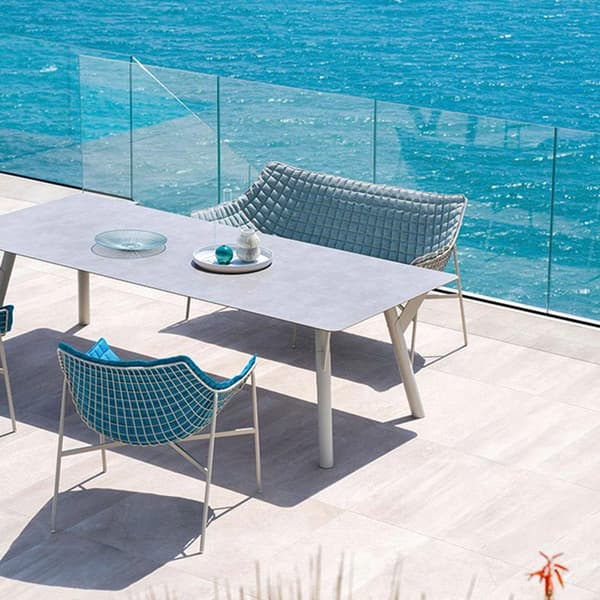
The Varaschin Link Extendable Table, designed by Alain Gilles, is one of the more architecturally resolved outdoor dining tables currently available. Its structure is powder-coated metal - available in a range of finishes from white through to moka and black - with legs also offered in solid teak from certified plantation.
The top is compact HPL, available in finishes including anthracite, cement, ardesia, and corten, each of which holds up to outdoor conditions with genuine conviction. The extension mechanism is straightforward and allows the table to move between sizes without compromising the visual clarity of the base - a detail that sounds minor but is, in practice, rather important when the table is in its compact configuration.
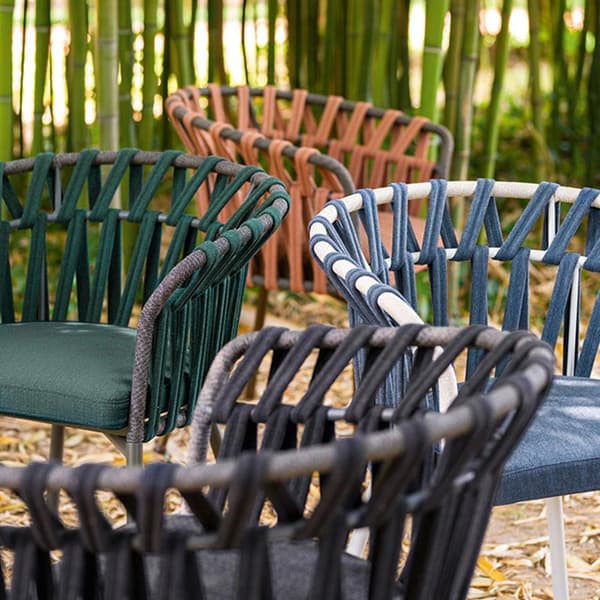
Paired with the Emma Cross Dining Armchair, also by Varaschin and designed by Monica Armani, the combination is particularly strong. The Emma Cross takes its form from the corolla of a flower - an enveloping backrest in which acrylic band weaving overlaps a rope-woven surface, creating a distinctive diagonal cross pattern across the backrest face. The aluminium frame is powder-coated; the seat is upholstered in a removable fabric bucket; the structure is weatherproof and UV-resistant. Available band colours include denim, rust, green, anthracite, and beige, each paired with a corresponding frame finish. This is a rattan dining chair set of 4 replacement that actually looks designed rather than merely decorative.
Key Takeaway: The Varaschin Link and Emma Cross pairing is a genuinely complete outdoor dining proposition - architecturally resolved at the table, sculpturally interesting at the chair, and specified from materials with a credible long-term performance record. The extendable table format makes it practical for households whose entertaining footprint varies across the year.
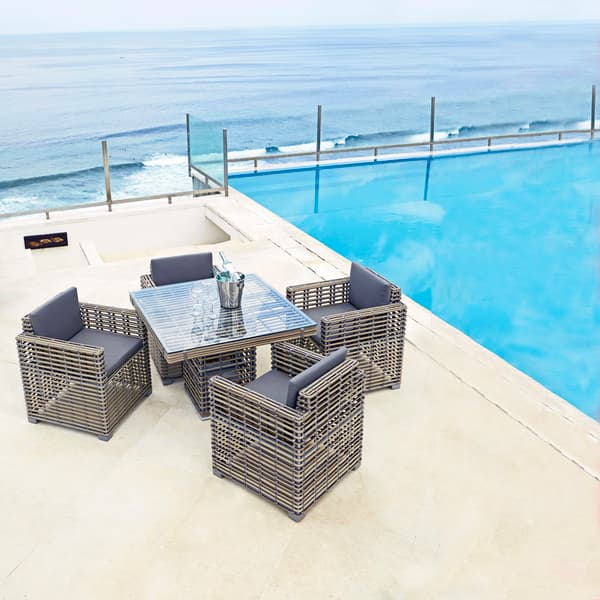
The Castries Dining Collection by Skyline Design is the option on this list that comes closest to the aesthetic register of traditional rattan dining chairs outdoor - and does so with considerably more structural integrity. The weave is Kubu Mushroom 15mm - a natural-looking tone that reads warmly against a silver walnut frame finish. The dining chair (Ref: 2327) measures 65cm wide by 65cm deep by 77cm high, with a seat height of 46cm and arm height of 66cm; cushions are specified in Basalto. The dining table range spans from a 100cm square four-seater (Ref: 2329) through to a 280cm rectangle for eight covers (Ref: 2328), with tempered grey painted glass tops across the range.
This is a set that works particularly well for gardens where the brief calls for something that reads as natural and relaxed rather than strictly architectural. The Kubu Mushroom weave has a textural richness that photographs don't fully convey - in person, particularly in afternoon light, it is a rather lovely material. The silver walnut frame finish is versatile enough to read against most garden material palettes without demanding that everything around it be selected in relation to it.
Key Takeaway: The Castries collection is the right answer when a client wants the warmth and textural quality associated with traditional rattan dining chairs outdoor but requires a set built to a higher standard of structural specification. The glass-topped table range is practical and easy to maintain, and the breadth of the table size offer means it can be specified correctly for most terrace footprints.
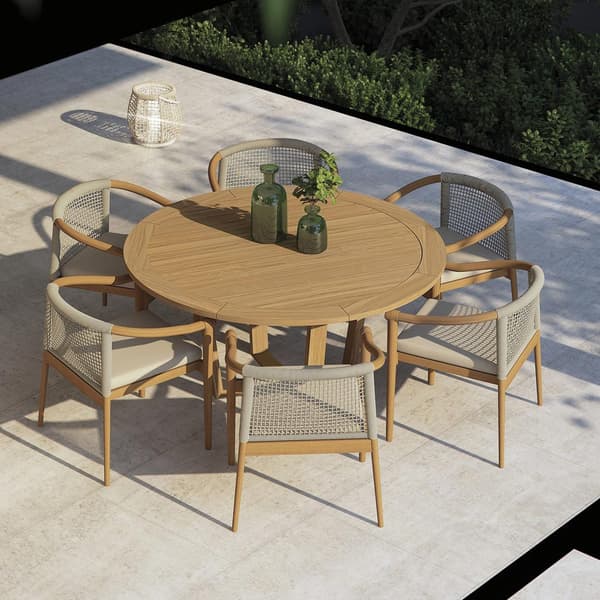
The Atmosphera Desert Round Table is one of the more quietly striking outdoor tables available in 2026. Designed by the Atmosphera Creative Lab, it is built on a solid Asian teak frame - 150cm in diameter, 78cm high, and a substantial 40kg, which tells you something about the seriousness of the construction. Solid teak at this diameter and gauge does not wobble, flex, or invite any anxiety about stability in wind. It simply sits, with considerable authority, and gets on with being a table.
The Onda Chair, designed by Busetti Garuti Redaelli for Atmosphera, is the seating complement that makes the Desert table scheme work as a complete dining proposition. Its name - wave, in Italian - describes the braided backrest that curves around the body, with an opening in the lumbar region that simultaneously lightens the visual weight of the chair and improves ventilation in warmer weather. Seat height is 48cm, which pairs correctly with the 78cm table height of the Desert.
At 5kg, it is light enough to reposition easily; it also stacks, which makes winter storage straightforward. Available in multiple finish options, including rope weaving variants and solid material versions, it is a refreshingly competent piece in a category where competence is not always guaranteed.
Key Takeaway: The Atmosphera Desert and Onda pairing is the most architecturally confident option on this list. The solid teak Desert table has a gravity and material honesty that places it in a different register from HPL-top or glass-top alternatives, and the Onda chair's sculptural backrest gives the seating genuine design presence at the table. This is the combination to specify when the brief calls for outdoor furniture that can hold its own beside serious interior design.
Q. Is synthetic rattan outdoor furniture worth buying in 2026?
For a short-term or secondary terrace where longevity is genuinely not a priority, synthetic PE rattan remains a usable choice. For any space treated as a genuine extension of the interior - where the furniture is expected to perform well for ten or more years - it is difficult to recommend over the woven rope, solid teak, and powder-coated aluminium alternatives now available at comparable or only modestly higher price points. The performance gap has widened considerably as the better alternatives have become more accessible.
Q. How many chairs should I pair with my outdoor dining table?
The practical answer is one more than you think you need, assuming storage allows. A household that entertains six regularly should specify an eight-cover arrangement - either a larger fixed table or an extendable one - so that the furniture is not visually strained on the occasions when all places are taken. A rattan dining chair set of 4 paired with a four-seat table leaves no flexibility; adding a second pair held in reserve is rather sensible for most households that entertain more than occasionally.
Q. What is the most durable outdoor dining chair material for a British garden?
Powder-coated aluminium frames with woven rope or acrylic band seating surfaces are, in my experience, the most durable combination for the British climate. The aluminium does not corrode, the rope does not unravel or fade as synthetic rattan does, and the construction is straightforward enough to remain structurally sound through temperature cycling and sustained moisture exposure. Solid teak is equally durable as a frame material but requires periodic treatment if you want to maintain the original honey colour; left untreated, it silvers gracefully over two to three seasons, which many clients find rather appealing.
Q. Can I leave outdoor dining furniture out over winter in the UK?
High-quality powder-coated aluminium and solid teak furniture can be left outdoors year-round in the UK with appropriate covers. Rope-woven seating can also remain outside, though bringing cushions indoors or into a dry store during sustained wet periods is sensible regardless of the fabric specification. The furniture categories that genuinely cannot remain outside without accelerated deterioration are those with untreated steel components, glass tops not rated for temperature cycling, and low-grade woven materials that absorb and retain moisture. If in doubt, a furniture cover is a minor cost relative to the investment in the set itself.
Address & Hours:
FCI London, Rays House, North Circular Road, London, NW10 7XP
Monday - Saturday: 10am - 6pm
Sunday & Bank Holidays: 11am - 5pm
Contact Details:
Phone: +442081531235
Email: [email protected]
What to Bring:
Rattan had its moment, and it earned it. But the outdoor dining category has matured into something more considered, and the best sets now available - whether teak-framed and architecturally spare, or woven and warmly textured - hold up to the standard of the interiors they adjoin. If you are ready to make the move, get in touch with our team to discuss your project.
"A true one-stop shop for elegant Italian design. It's rare to find such a well-curated selection all in one place in North London. The team are knowledgeable and happy to advise, while still giving you space to browse at your own pace. There are often great offers too - always worth asking the designer about current promotions."
Elisa Foppa - Customer
"We purchased dining chairs and island chairs from this store, and we couldn't be happier. The quality is excellent, and everything arrived exactly on the date we were promised. Aziz explained everything clearly from the start and guided us through the whole process with ease. We highly recommend this store - great communication, great service, and fantastic products."
Przemyslaw Bilik - Customer
"Our designer at FCI provided great customer service with his expertise and advice. The quality of the chairs and bar stools are excellent and fit in with our kitchen well."
Carol O'Regan - Customer
We help designers & clients transform mundane spaces into extraordinary ones.


Book a video consultation and we'll advise you on furniture, space planning, colour schemes and much more.
Book A ConsultationBook a visit to our stunning, multi award-winning, 30,000 sqft.
Over 700 brands under 1 roof.
Most Popular on FCI London: Fitted Wardrobes | Luxury Designer Rugs | Luxury Sofas | Luxury Furniture Store | Luxury Interior Designers | Luxury Bedroom Furniture | Luxury Modern Chairs | Luxury Coffee Tables | Luxury Designer Kitchens | Luxury TV Units | Luxury Dining Tables | Luxury Storage Solutions | Luxury Sideboards | Luxury Stools & Bar Stools | Luxury Bespoke Joinery | Luxury Modern Hallway Furniture | Furniture Showroom Appointment | Luxury Lighting | Modern Luxury Outdoor Furniture
Transparency isn’t a policy. It’s a principle.
Have a peek at what our clients really have to say.